Living Room / Console Table Decor
Console Table Decor Ideas for a Balanced, Useful Surface
A console can give a blank stretch of room a clear purpose. It can also become a long shelf for unrelated objects, with a lamp at one end and everything without a home gradually filling the middle.

Useful console table decor ideas begin with a focal point, a practical light where needed, and a small place for daily essentials. The pieces should relate to the furniture’s width and depth while leaving enough clear surface to use it comfortably.
Start by deciding what happens at the console. An entry landing place, a living-room display, and a surface behind a sofa may need different arrangements even when the furniture is similar.
Give the Surface a Clear Everyday Role
Remove the existing objects and notice what returns during a normal day. Keys, glasses, a book, or a bag may explain more about the console’s useful role than a photograph of a styled room.
Choose which of those items should stay and which need another home. Then reserve a practical landing area before adding accessories.
Check stability and follow the furniture’s securing instructions. If a drawer or shelf is included, make sure it is usable in the proposed location. The surface arrangement should not hide a fit problem beneath it.
Keep the console’s role specific. It does not need to become a complete entryway makeover or duplicate every decorative feature already present in the room.
Plan a Focal Point, Light, and Daily-Storage Zone
Sketch the console from the front and mark the main elements. Give each a purpose while preserving open surface between groups.

The diagram shows one way to relate a focal point, lamp, and small daily-storage area. It is illustrative, with no fixed room measurements or compulsory divisions.
Include the full lamp shade, frame width, tray, and any projecting handles when testing the arrangement. A base that fits does not mean the complete object is proportionate.
Use paper templates for larger pieces and set the actual daily items on the surface. This makes it easier to identify where the decorative group should end and useful space should begin.
Anchor a Console Against a Wall With One Artwork
When deciding how to decorate a console table against a wall, start with the relationship between the furniture and the focal point above it.
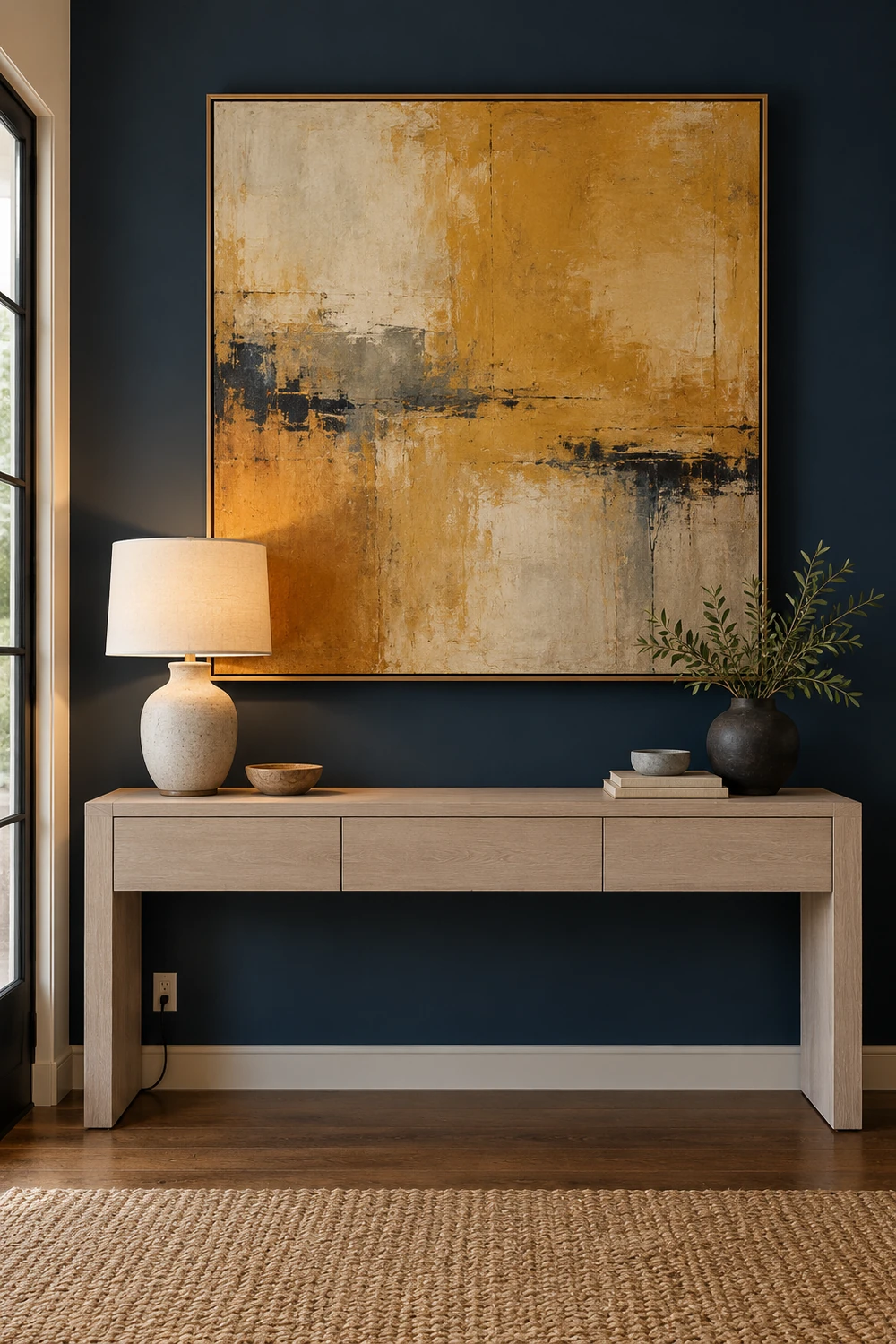
The large ochre artwork gives the pale ash console a clear visual center against the ink-blue wall. The smaller accessories support that relationship rather than forming another competing display.
Measure the outside frame dimensions and test them with a paper outline. Look from the doorway and from the seats that face the console.
Choose an arrangement that relates to the furniture without filling every part of the wall. Follow appropriate hanging instructions for the artwork and wall construction. A large image should have suitable support, not depend on the console as an unsecured resting place.
Choose a Mirror When Its View Is Useful
A mirror can be a practical focal point near an entrance or a way to bring a considered reflected view into a living room.

The round brass mirror is proportioned to the slim charcoal console. Its curve provides contrast while the accessories stay relatively quiet.
Stand where the mirror will be used and check what it reflects. Include the view from the sofa or doorway if those positions are important to the room.
Mount the mirror according to its weight, hardware, and the wall’s requirements. Choose the final location for function and reflection as well as appearance; a mirror that only works from one awkward angle may not be the best focal point.
Balance One Lamp With Lower Pieces
A single lamp can establish height at one side of the console. The opposite group can remain lower when its breadth, color, or texture provides enough visual presence.
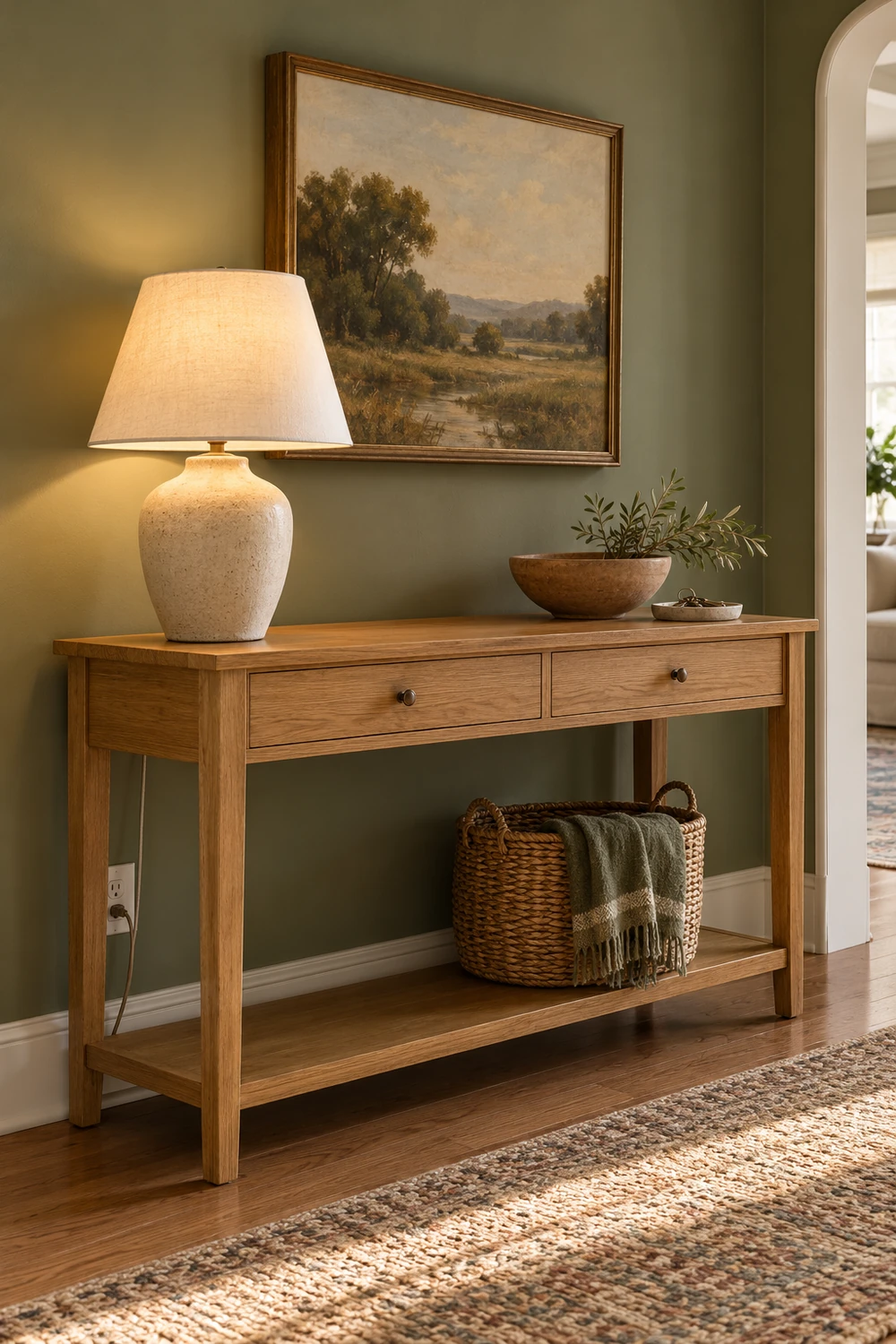
The oak example pairs one lamp with a bowl and key dish. It leaves the surface understandable instead of stretching small objects across the whole width.
Check the lamp base and shade against the usable depth. Route the cord to a suitable outlet without trapping it in drawers or leaving it across circulation.
Turn the lamp on before deciding the arrangement is finished. Its light and reflected highlights can change how the objects appear beside it.
Use Paired Lamps Only Where the Surface Supports Them
Two lamps can give a longer console a clear symmetrical outline. The arrangement needs enough depth for both bases and enough open space that the center remains useful.
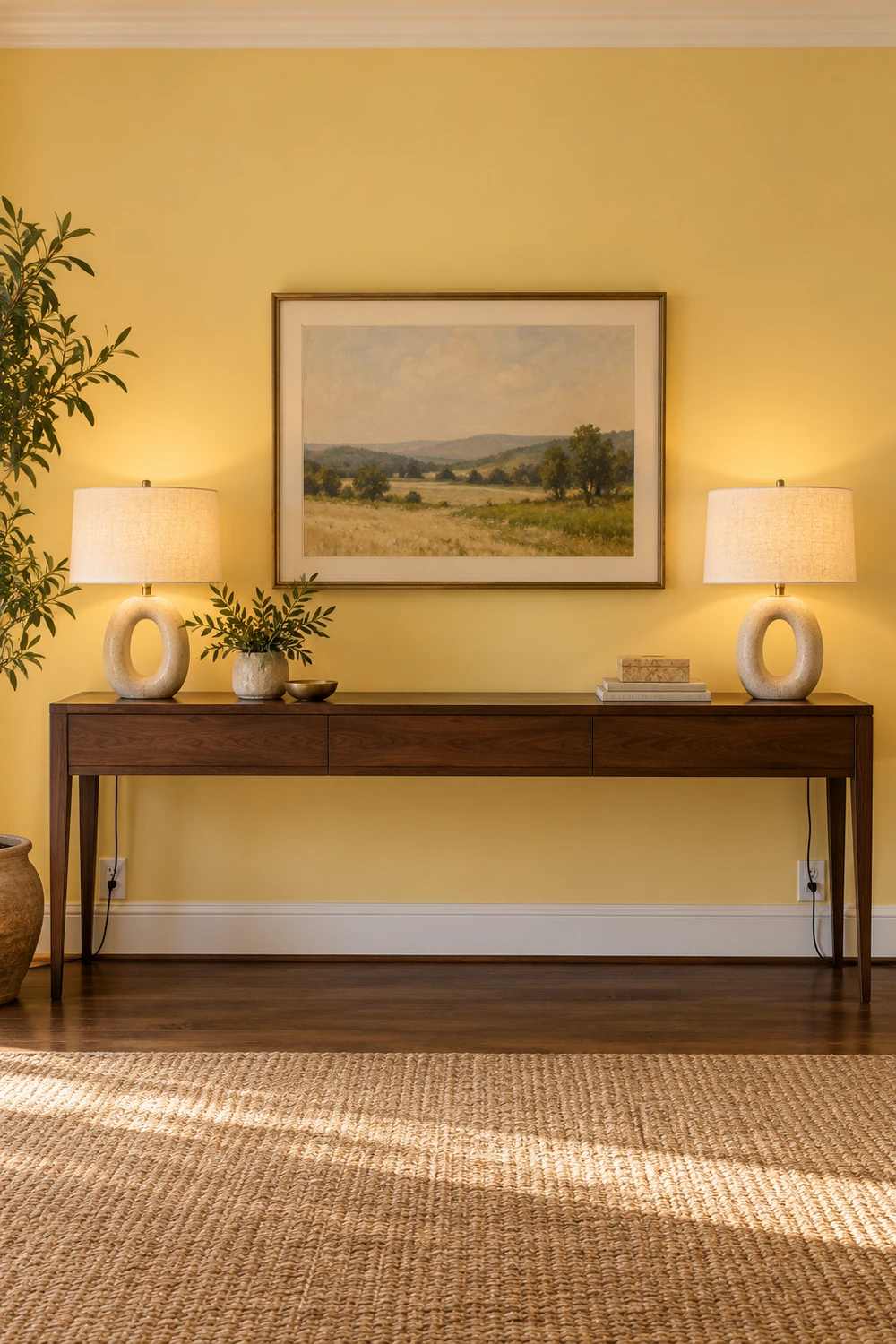
The paired lamps here frame a relatively quiet central area. Their repetition provides structure without requiring a large collection of smaller pieces between them.
Include both shade widths in the layout. Lamps may crowd a mirror or artwork even when their bases appear widely separated.
Consider outlet positions and switching convenience before choosing the pair. Symmetry is not a reason to accept an awkward cord route or place a lamp where it cannot be used comfortably.
Give Keys and Glasses a Small Defined Home
A daily tray can prevent loose essentials from spreading along the console. Choose a size that fits the actual items rather than the largest tray the furniture can hold.
The leather tray contains keys and sunglasses on the oak surface. The surrounding clear area leaves room for setting something down temporarily.
Place the tray where you naturally reach on arrival. If it is behind a vase or beside a difficult corner, the essentials will probably keep landing somewhere else.
Keep the category edited. Spare chargers, unopened mail, and old receipts need their own decisions instead of becoming permanent layers in a decorative tray. For grouping objects on a lower living-room surface, our coffee table tray decor ideas cover that separate setting.

Use Shallow Accessories on a Narrow Console
A slim console needs objects whose full footprints remain supported. Check the widest rim, shade, or branch spread rather than just the point touching the table.

The shallow accessories on this metal console suit the limited depth. They leave the furniture visible and avoid turning the narrow top into an overhanging display.
Test the setup while walking past. A piece that projects into the route may be easy to catch with a bag or sleeve.
If an object is too deep, give it another home. A console does not become more practical by supporting only part of a large vessel or by pressing everything tightly against the wall.
Divide a Long Surface Into Related Groups
A longer console can support separated groups, but it does not need a continuous row. Give the eye a rhythm of objects and clear surface.

The pale green example uses distinct groups connected by a restrained palette. The gaps make each group legible.
Begin with the focal point and the largest surface object, then add the useful daily zone. Stop and look at the entire arrangement before filling the remaining spaces.
Avoid placing a small object at every interval merely to distribute the collection evenly. Unequal gaps can feel natural when the groups have a clear visual relationship and the surface remains useful.
Fit Baskets Beneath Without Blocking Movement
The lower area can hold a defined storage category when the furniture and room allow it. Choose baskets by their contents and the available opening.
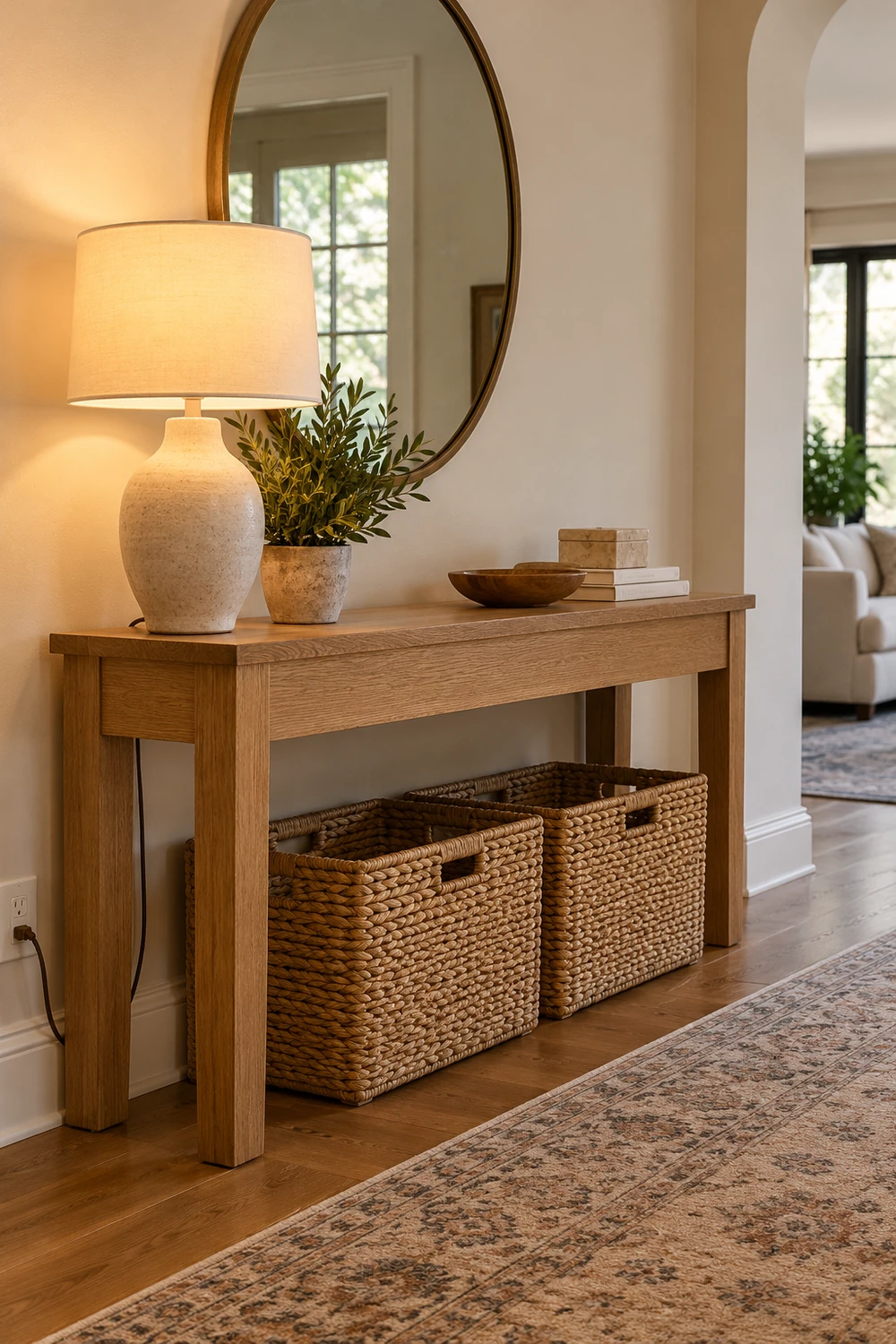
The two baskets beneath this console fit inside its structure rather than projecting into the route. Check their full loaded dimensions, including handles and any contents rising above the rim.
Leave room to pull them out and return them comfortably. Follow the shelf’s load guidance if the baskets rest on a lower tier.
Keep the category recognizable, such as throws or another suitable household group. Hidden miscellaneous overflow can make the room look finished while leaving the storage problem unresolved.
Let Sculptural Furniture Do More of the Decorating
Modern console table decor ideas can be particularly restrained when the furniture itself has a strong shape. A few clear accessories allow that form to remain visible.

The cream console, black lamp, and low bowl create contrast without adding a separate collection. The furniture’s outline remains the largest decorative statement.
Look at the side view and the open area beneath it as well as the top. Accessories should complement the whole silhouette rather than obscure its distinctive features.
Keep a useful landing area where the room needs one. A sculptural console can still serve everyday life; it does not have to function only as an untouchable display.
Give a Traditional Console a Collected Material Mix
A more traditional room can support layered materials while retaining a clear arrangement. Choose pieces that have a visual relationship rather than matching every finish.

The mahogany console combines a brass lamp and blue-white ceramics. Their different surfaces provide interest without needing a dense assortment of small objects.
Let one piece lead and keep the supporting group lower or quieter. An ornate frame, patterned ceramic, and detailed furniture can each contribute enough character on their own.
Step back and remove anything that disappears in the larger composition. A smaller number of legible pieces often looks more collected than an assortment in which nothing can be seen clearly.
Adapt the Arrangement Behind a Sofa
A behind-sofa console has no wall immediately above it, so the focal-point approach changes. Consider the view from both sides and the route around the furniture.
The slim birch example uses a restrained surface group rather than adding a freestanding wall-style composition behind the seating.
Check object stability and the way people lean or move near the sofa. Keep pieces clear of ordinary head and arm movement.
If a lamp is used, plan a suitable cord route and outlet connection. Avoid stretching a lead across circulation to reproduce an arrangement that does not suit the room’s electrical layout.

Vary Height Through Related Materials
A useful console arrangement can include a tall lamp, a medium vessel, and a low bowl or tray. The materials help connect those different shapes.
Walnut, ceramic, bronze, and linen provide varied texture in the close view. The objects remain distinct without looking unrelated.
Height variation is not a requirement for three new accessories. Use the pieces needed for the surface’s role and let the wall focal point contribute to the composition.
Check the full arrangement from room distance. Several small height differences may be less visible than one clear tall element and a broad lower group.

Walk Past the Console With the Room in Use
Furniture depth and accessory projection affect circulation together. Check the route while carrying the bag or household items you normally move through the room.

Open nearby doors and console drawers. Pull out the lower basket if there is one. Make sure there is a comfortable place to stand while using the storage.
The photographed route is an example, not a universal clearance measurement. Test the actual layout and the needs of the household.
If the main task is arranging the wall beyond the furniture, our entryway wall decor ideas cover that broader wall-only scope. The console arrangement should remain tied to the surface and its use.
Check the Lamp Arrangement After Sunset
Switch on the lights normally used in the room and look at the console from nearby seats and the entrance.
The evening example shows how shaded light changes the walnut surface and artwork. Check for distracting reflections in a mirror or glazed frame, then adjust the lamp where appropriate.
A similar material can connect this surface to another focal point without copying it. Our mantel decor with a mirror guide addresses the different shelf, reflection, and fireplace requirements of that arrangement.

Frequently Asked Questions
How do you decorate a console table without clutter?
Choose one focal point, useful lighting where needed, and a small daily-storage group. Leave open surface between the pieces and keep overflow items elsewhere.
Should you use art or a mirror above a console?
Choose by the room’s function and view. Artwork can establish a palette; a mirror can support a daily task or a considered reflection. Test scale and position before installing either.
What belongs on a narrow console?
Use shallow objects with complete footprints supported by the top. A compact tray, suitable lamp, or low bowl may be enough. Check the walking route as well as the surface fit.
Keep the Arrangement Connected to Everyday Use
When deciding how to decorate a console table, start with its purpose and the room around it. Establish the focal point, choose a manageable surface group, and test storage and circulation. The most settled arrangement is one you can use, clean, and return to order without moving a collection of unnecessary objects.