Kitchen Storage / Kitchen Drawer Organization
Deep Kitchen Drawer Organization Ideas for Pots, Dishes and Containers
A deep drawer can hold the cookware that never fits neatly into a shallow one. It can also become a place where lids slide underneath pots and food containers turn into a stack you have to dismantle every day.

Practical deep kitchen drawer organization ideas give the height a clear purpose. Measure the usable interior, choose a few compatible categories, and separate them so each group is easy to remove and return. The drawer should close smoothly with everything in its everyday position.
Begin with the items you reach for regularly. A deep drawer works better as accessible storage than as a place to pack every spare kitchen piece you own.
Empty the Drawer and Identify the Access Problem
Take everything out and group it on a nearby surface: cookware, lids, dishes, container bodies, and container lids. Notice what was difficult to retrieve before choosing an organizer.
If one pan always sits beneath three others, the problem may be the stack. If lids slide into gaps, they may need their own divided zone. If the drawer jams, a tall handle or unstable pile may be crossing its usable opening.
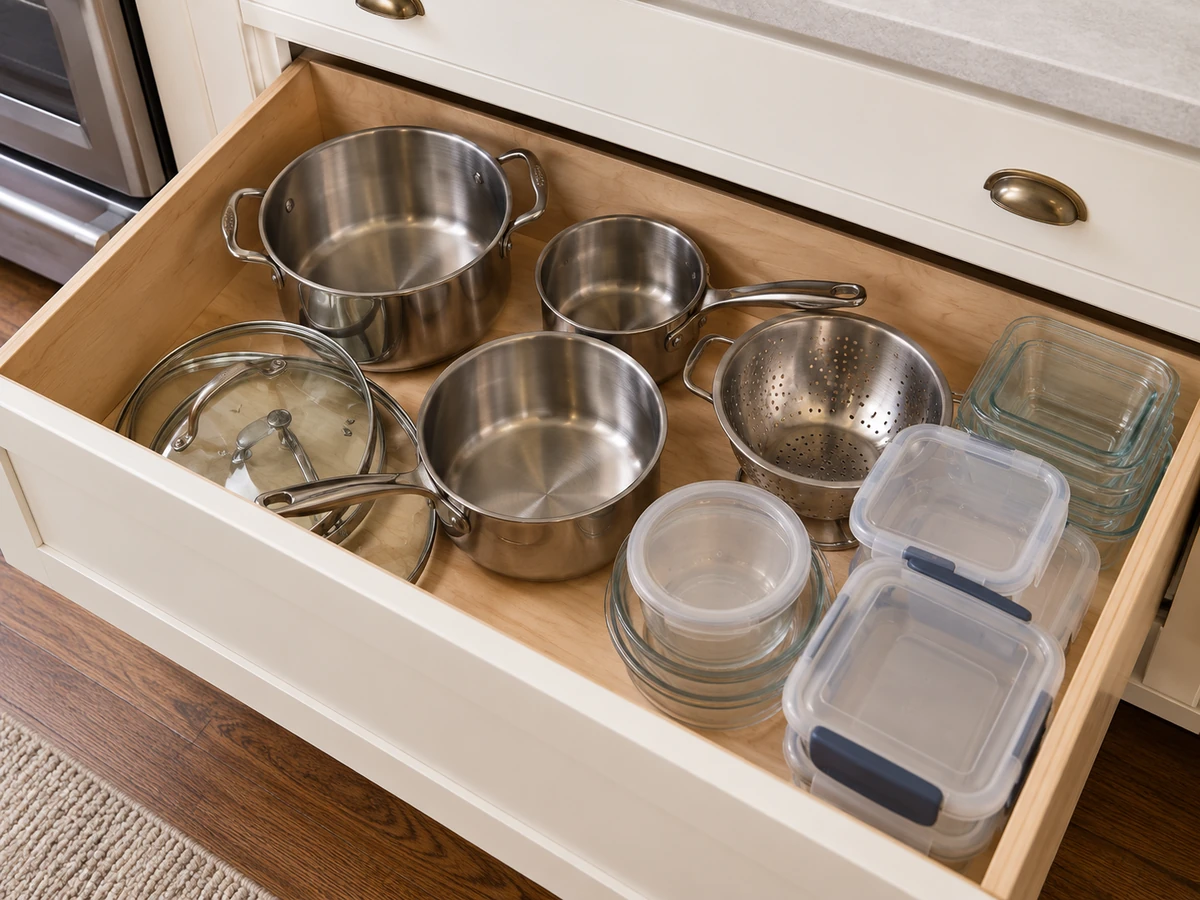
The before-and-after design concept in this guide keeps the same drawer and viewpoint while changing the arrangement inside it. Use that comparison to think about access rather than treating a full drawer as the goal.
Keep the regular-use pieces nearby and consider another home for occasional items. A drawer should not have to hold several incompatible categories just because they technically fit.
Measure the Interior and the Closing Opening
Drawer fronts can conceal a smaller usable interior. Measure inside the drawer box, including any change in width or depth caused by fittings.

Record the internal width, front-to-back depth, and usable height beneath the cabinet opening. Check for runners, crosspieces, screws, or anything else that affects the organizer footprint.
The closing opening matters as much as the drawer side height. A pot handle may rise above the side yet still fit, or it may catch the cabinet even though the rest of the pot sits low.
Use your actual measurements when selecting deep kitchen drawer organizers. The illustration identifies what to measure; it does not supply measurements for your kitchen.
Test proposed compartments with cardboard or existing containers before purchasing inserts. Include the full width of handles and the movement needed to lift each item out.
Make a Category Plan Before Buying Inserts
Choose the drawer’s main role according to the kitchen task nearby. Cookware may belong near the cooking area, while food containers may work better near the place where leftovers are packed.
Avoid assuming the featured multi-category arrangement is the right plan for every drawer. Some drawers work best with cookware alone; others comfortably hold dishes and containers in separate zones.
List the outside dimensions of the proposed organizers next to your measured drawer interior. Leave enough room to grip items and remove inserts for cleaning.
A kitchen deep drawer organizer should solve a particular movement problem. Adjustable dividers help separate categories; a fitted peg system can restrain dishes; narrow slots can contain lids. Choose by the job rather than by how complete a matching set looks.
Nest Pots Without Trapping Their Handles
Nesting cookware can make use of depth when the pieces are designed to store together. Keep the stack manageable and arrange handles so they do not lock neighboring groups into place.

The example uses separators between nested saucepans. Follow the cookware manufacturer’s guidance for appropriate protection, especially where finishes could rub together.
Test the pot you use most. If removing it requires lifting a heavy stack every evening, change the order or store fewer pieces in that group.
Avoid wedging handles against the drawer walls. Leave enough room to grasp the cookware securely without catching another pan. Check the total load against the drawer system’s guidance rather than judging capacity from the remaining empty space.
Give Pot Lids Their Own Upright Slots
Lids are easier to see when they are separated rather than stacked loosely beneath cookware. Upright divisions can make use of a deep drawer’s height.

Measure the whole lid in its stored position, including the knob or handle. Check whether it stays below the usable cabinet opening as the drawer moves.
Choose slots that hold the lids without forcing them tightly together. You should be able to lift one out without pulling out its neighbor.
If a lid is too tall, try a different suitable orientation or another storage location. Do not force the drawer closed or assume a divider can support a configuration outside its intended use.
Restrain Dish Stacks With a Fitted System
Plates and bowls can work in a deep drawer when the drawer and organizer are suitable for their weight. A fitted peg arrangement can keep separate stacks from sliding into one another.
Set the divisions around the actual dishes rather than estimating from the diameter of one plate. Include enough finger space to lift the stack or individual piece comfortably.
Keep stack heights manageable for the person using them. A very tall pile may use the available height efficiently but be awkward to handle.
Check that the system sits securely and does not interfere with the runners or closing movement. Follow the drawer and organizer instructions, including load limits. The visual example demonstrates a storage approach, not a universal capacity claim for all drawers.

Group Container Bodies by Compatible Size
Food-container bodies often store more clearly when nested by compatible shape and size. Keep unrelated pieces out of a stack that only partly fits together.
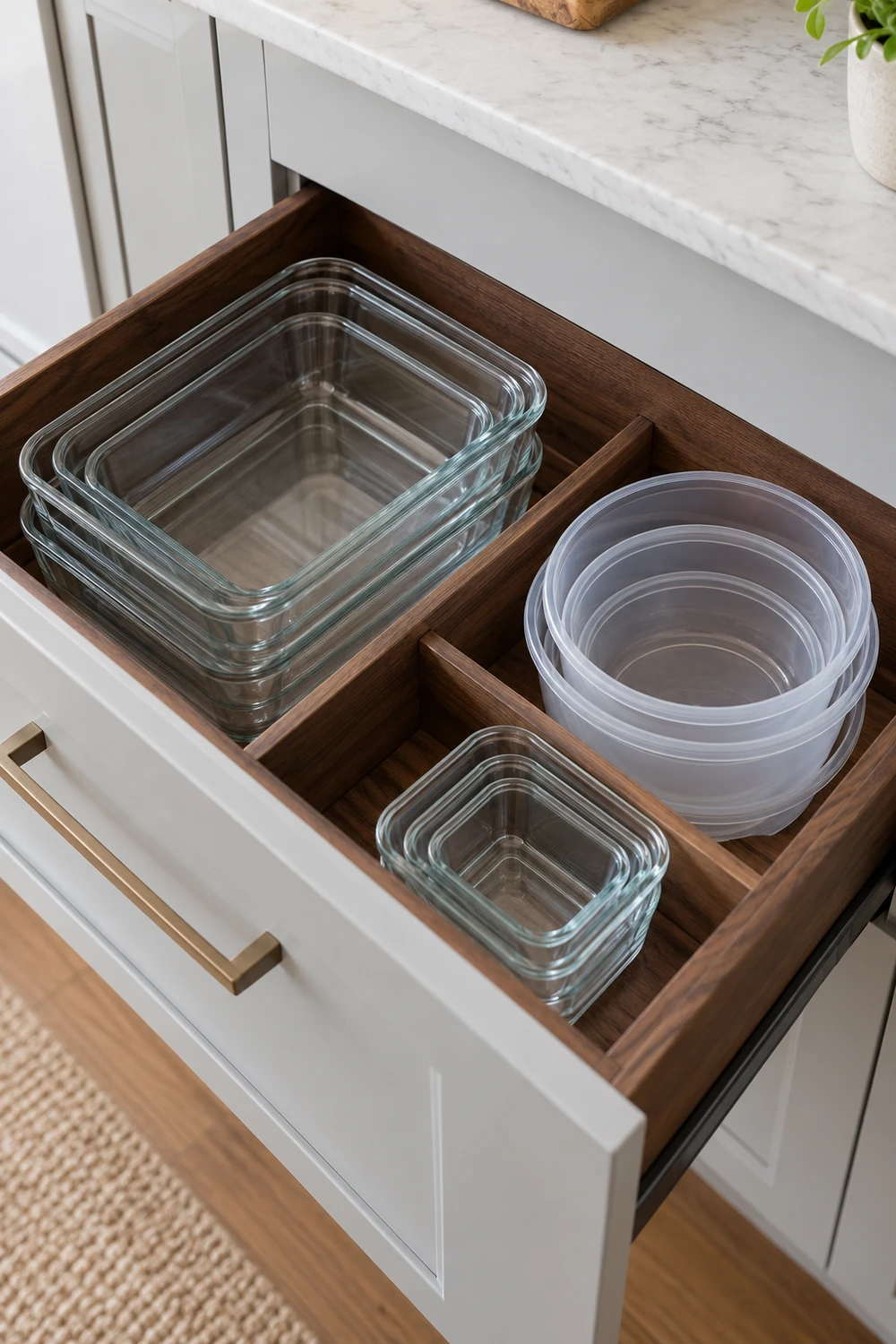
Match each container with its lid during the sorting stage. Remove broken pieces and relocate useful extras that do not belong in the daily group.
Keep the nesting order easy to maintain. If a larger container repeatedly ends up balanced on a smaller one, the stack may contain too many shapes.
Leave space to lift the entire group if needed. A tight compartment can make nesting efficient on paper while turning retrieval into a struggle. It is often better to hold fewer compatible containers than a large mixed collection.
File Container Lids Separately
An upright lid section makes sizes easier to scan and prevents a loose pile from spreading beneath other items.

Group lids by the container family they fit. The division does not have to be complicated: one slot for the daily rectangular set and another for the round pieces may be enough.
Test the lid handles and raised rims against the compartment width. They can require more space than a flat outline suggests.
Keep enough room to remove one lid without bending or squeezing the rest. When the section becomes overfilled, check the matching bodies before adding a larger organizer. The problem may be unmatched extras rather than a shortage of drawer space.
Give Long Tools a Fitted Compartment
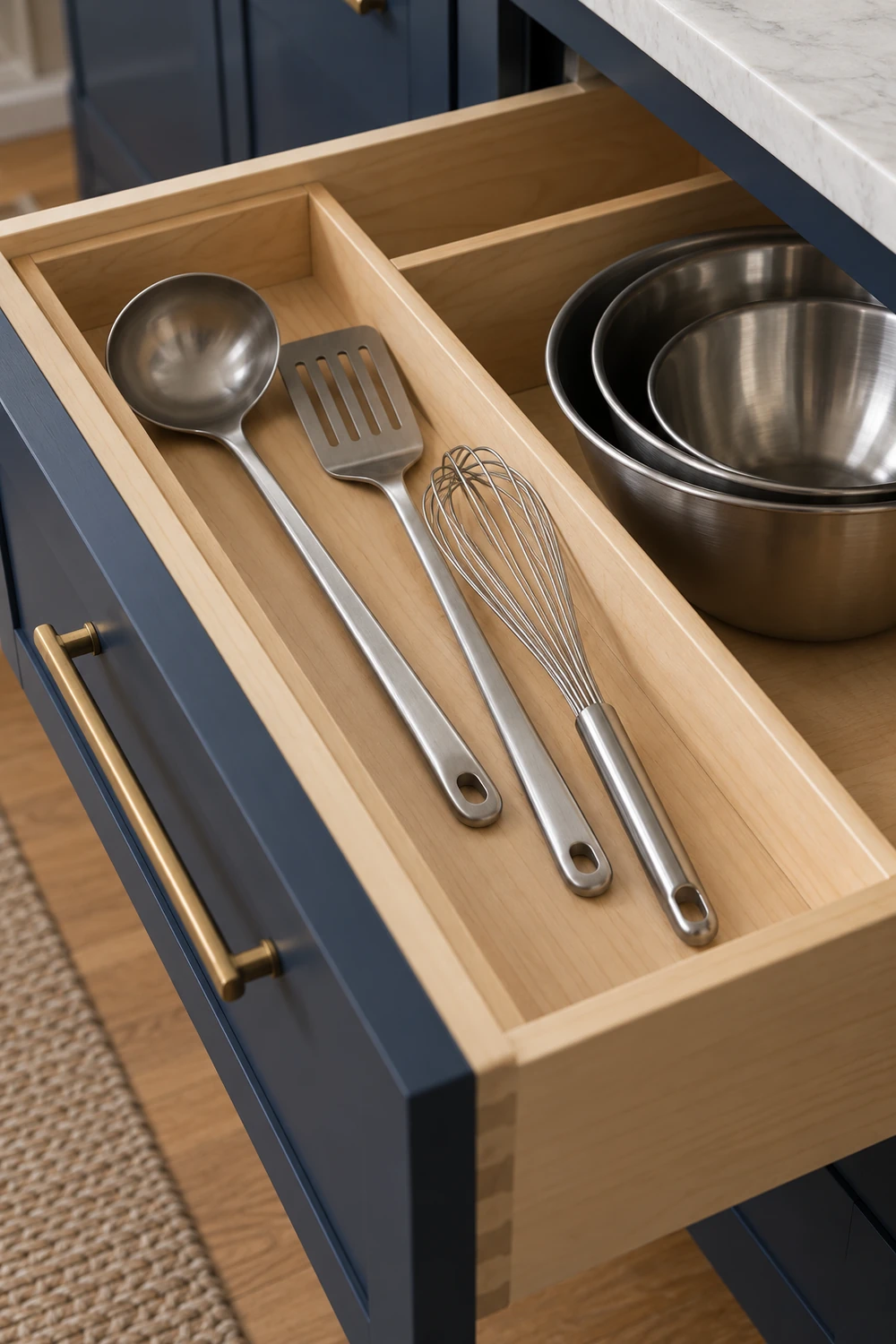
A deeper drawer can accommodate awkward utensils, but their length and shape still need a defined place. A fitted compartment prevents long tools from rolling into neighboring categories.
Arrange the handles so the tools are easy to identify and pick up. Keep sharp tools in storage designed for them rather than mixing them loosely into the same section.
Check both the tool length and any raised head or grip. A utensil may fit flat but shift during drawer movement, so test the arrangement by opening and closing it gently.
Keep this section focused on the tools that need the depth. Everyday flatware may use a shallower drawer more efficiently.
Stabilize the Base Without Hiding a Poor Fit
A suitable non-slip liner can help reduce movement under compatible inserts. It should lie flat and allow the drawer to function normally.
Follow the drawer and liner care guidance. Check underneath periodically for crumbs or moisture, and let the surface dry before replacing the liner.
The liner is not a substitute for correctly sized dividers. An insert that rocks, bends, or catches the opening needs a different fit.
Test the loaded arrangement rather than only the empty organizer. Weight can change the way an insert sits, and a compartment that looks secure while empty may shift when a pot is returned to it.

Limit Categories in a Narrow Deep Drawer
A narrow deep drawer may work best with one main category and a small supporting section. Trying to combine cookware, dishes, and containers can leave every group awkwardly restricted.
Choose what benefits most from the location. That might be a few everyday pots with their lids, or a compact container set with filed lids beside it.
Do not fill a narrow leftover gap simply because another object can be squeezed into it. That gap may be the space needed to grip a handle or remove an insert.
If another category needs a home, consider the kitchen’s wider storage plan. Our guide to organizing a pantry cabinet addresses food-storage zones in a different type of space.

Draw the Drawer From Above
A quick plan makes it easier to compare organizer footprints before committing to a layout. Mark the drawer front, then sketch the groups using your own internal measurements.

| Zone | What to plan around | Retrieval test |
|---|---|---|
| Cookware | Pot diameters and handle direction | Remove the regular-use pot without dismantling the stack |
| Dishes | Stack footprint and total weight | Grip the dishes comfortably within the restraints |
| Container bodies | Compatible nested shapes | Lift a container without moving another category |
| Lids | Height, handles, and slot width | Select one lid without pulling out several |
The diagram is an example of category relationships. Adapt it rather than assuming every drawer should contain all four groups.
Compare the Reset by Daily Retrieval
The proposed reset uses removable divisions to separate the same drawer’s contents. The important improvement is not a fuller drawer; it is a clearer path to each category.

Try a real kitchen task: take out a pot, find its lid, and return both after use. Then pack a container and retrieve its matching lid.
If either task requires moving unrelated items, revise the divisions. A practical layout should be understandable to someone else in the household too.
Finish With a Slow Closing Check
Return everything to its ordinary position and close the drawer gently. Stop if an item catches, rubs, or shifts into the opening.
Check the tallest handle, lid, utensil, and container stack. Adjust the storage rather than pushing against resistance.
Then open the drawer again and confirm that the groups remain stable. Repeat the check after normal use, because an arrangement that only closes when every handle is perfectly aligned may need more breathing room.
Keeping the drawer useful can also reduce the need to leave spare tools on the worktop. Our kitchen counter decor ideas focus on that separate surface and its prep space.

Frequently Asked Questions
How do you organize a deep kitchen drawer without wasting height?
Use categories that benefit from depth, such as cookware, dish stacks, or suitable upright lids. Measure the closing opening and choose divisions that keep each group accessible rather than filling the height with unstable stacks.
Should pots and lids stay in the same drawer?
They can, if the drawer supports the loaded weight and both groups fit comfortably. Separate the lids so retrieving one does not require lifting the cookware.
What if a deep drawer is still difficult to use after adding organizers?
Check whether it holds too many categories, whether handles overlap, and whether the inserts leave enough gripping space. Remove a group before buying another layer of storage.
Let the Drawer Support the Kitchen Routine
When working out how to organize a deep kitchen drawer, start with measurements and the items used nearby. Build a few clear zones, check the loaded movement, and preserve space to grasp and return everything. Depth is most useful when it makes storage easier to reach rather than harder to unpack.