Kitchen Storage / Pantry Organization
Corner Pantry Organization Ideas That Keep the Back Reachable
Corner pantry organization has one particular challenge: the place where two shelf runs meet can become difficult to see and reach. Filling that junction with tall packages may increase the amount stored, but it also hides what sits behind them. A better plan keeps the corner understandable and lets nearby containers move without colliding.
Work with the pantry you have. You may only need shorter bins, a smaller turntable or a clearer division between the two sides. The useful question is not how much can fit, but whether you can retrieve it easily.
Find the corner’s actual access problem
Open the pantry and identify what disappears at the junction. Tall boxes might block jars, a basket might cover both shelf runs, or several bottles might require moving before you can reach the back. Name that specific problem before buying organizers.
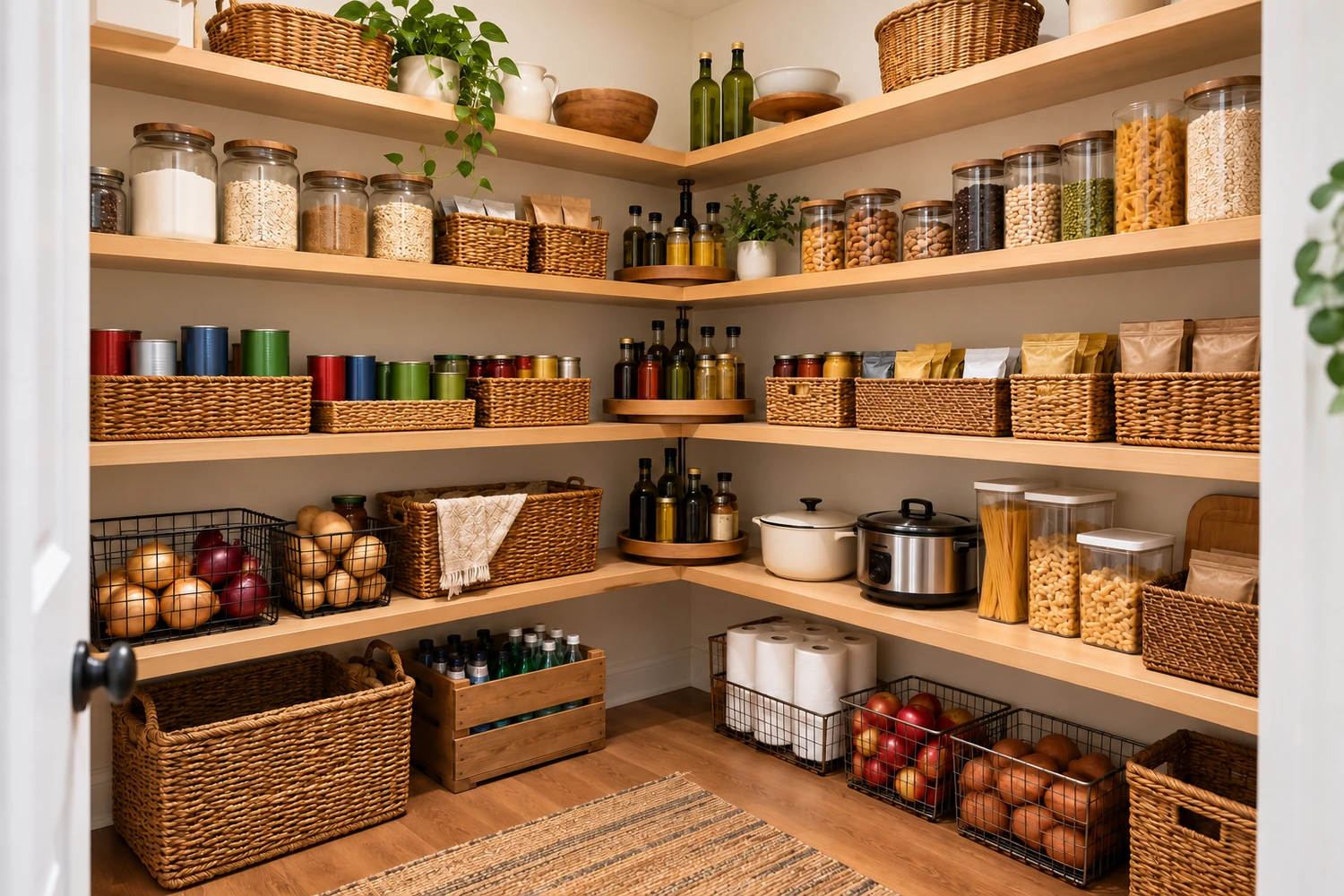
The starting pantry pictured here introduces a proposed reset shown later in the article. Its shelves and corner remain the same; the arrangement changes to make stored food easier to identify.
Sort the corner’s contents into daily food, occasional ingredients and reserves. Move unrelated items out of the junction temporarily. Notice what you can see from the doorway and what only becomes visible after you step inside. That sightline helps determine which categories belong at the front of each shelf run.

Plan the two shelf runs and their junction together
Treat an L-shaped shelf as two connected arms with one shared turning area. Place short, removable groups along the arms and give the inside corner a deliberate role rather than using it for whatever remains after everything else is arranged.

The diagram suggests a front retrieval zone, limited lightweight reserves behind it and a supported turntable near the junction. These are illustrative relationships, not measured reach distances. Test them with your own shelves and the people who use the pantry.
Use empty containers or paper templates to try a layout. Move one bin out while leaving its neighbor in place. If the two containers collide at the corner, shorten a bin or leave a larger gap. Solving that movement early prevents the shelf junction from becoming a permanent bottleneck.
Use a small turntable for a manageable bottle group
A turntable can bring small bottles forward when their labels would otherwise disappear behind one another. The example groups a modest selection instead of covering the entire corner with a large rotating platform.

Choose bottles you use often enough to justify this accessible position. Keep their caps closed and follow the food labels’ storage directions. Tall or unusually shaped bottles may be more stable in a different arrangement, so test the actual group rather than assuming every condiment belongs together.
Turn the loaded tray slowly and retrieve a bottle from several positions. If the labels remain hidden or the containers knock against one another, reduce the number. A turntable is useful when it improves access; it does not need to hold every bottle in the pantry to earn its space.
Check support and rotation clearance
The turntable needs a stable shelf footprint and room to rotate without hitting walls or neighboring containers. The close view shows why its relationship to the corner matters as much as its diameter.

Follow the organizer manufacturer’s support and load requirements. Do not balance a turntable across an unsupported shelf gap or let it overhang a narrow edge merely because it appears to fit from the front. Confirm the loaded tray sits securely throughout its movement.
Use the tallest actual bottle during the test. A tray may rotate freely when empty but hit the wall once a wide label or handle projects beyond its rim. Keep surrounding shelf space clear enough that a nearby packet or bin does not drift into the turning path during ordinary use.
Stop long bins before they block the junction
Short bins on each arm of the L can contain packets and small packages without trapping the containers beside them. The pictured arrangement leaves the meeting point readable instead of bridging it with one deep basket.

Measure container dimensions against the full retrieval path, not just the shelf where the bin will sit. Include handles and any flexible sides that may bulge when filled. A shorter bin with a little unused shelf behind it can be more useful than a longer one that cannot come out independently.
Keep one clear category in each bin. If a container holds breakfast packets, snack bars and baking decorations together, its portability does not solve the search problem. Grouping and access need to improve at the same time.
Assign a different food group to each arm
Separate shelf runs can support related but distinct groups, such as breakfast on one side and baking ingredients on the other. The example uses that division to make the L-shaped layout easier to understand at a glance.
Choose categories based on how your household cooks. If breakfast is only a small group, do not reserve an entire shelf run for it while another category overflows. Begin with approximate zones and adjust after using the pantry for a week.
Place shared ingredients where their location stays obvious. A jar used for several tasks does not need duplicate homes. Keep the category boundary consistent enough that groceries return to the same area, while allowing a little room for changes in package size and shopping habits.

Put heavier items in a comfortably reachable lower zone
Lower shelves can suit heavier food containers or cookware when they are easy to reach and the shelves are rated for the load. The pictured arrangement keeps heavier pieces below lighter groups rather than placing them at the upper corner.
Judge the full movement: lifting a container from a low shelf, bringing it past the corner and returning it. The deepest floor-level position may be inconvenient even if it technically holds the item. Avoid crowding several heavy objects into a basket that becomes difficult to handle.
Follow shelf and organizer capacity information, and keep food in suitable conditions according to its packaging. The photograph illustrates placement, not a measured load recommendation. If the shelf flexes, the organizer shifts or retrieval feels awkward, revise the arrangement rather than adding more weight.
Keep upper reserves light and clearly limited
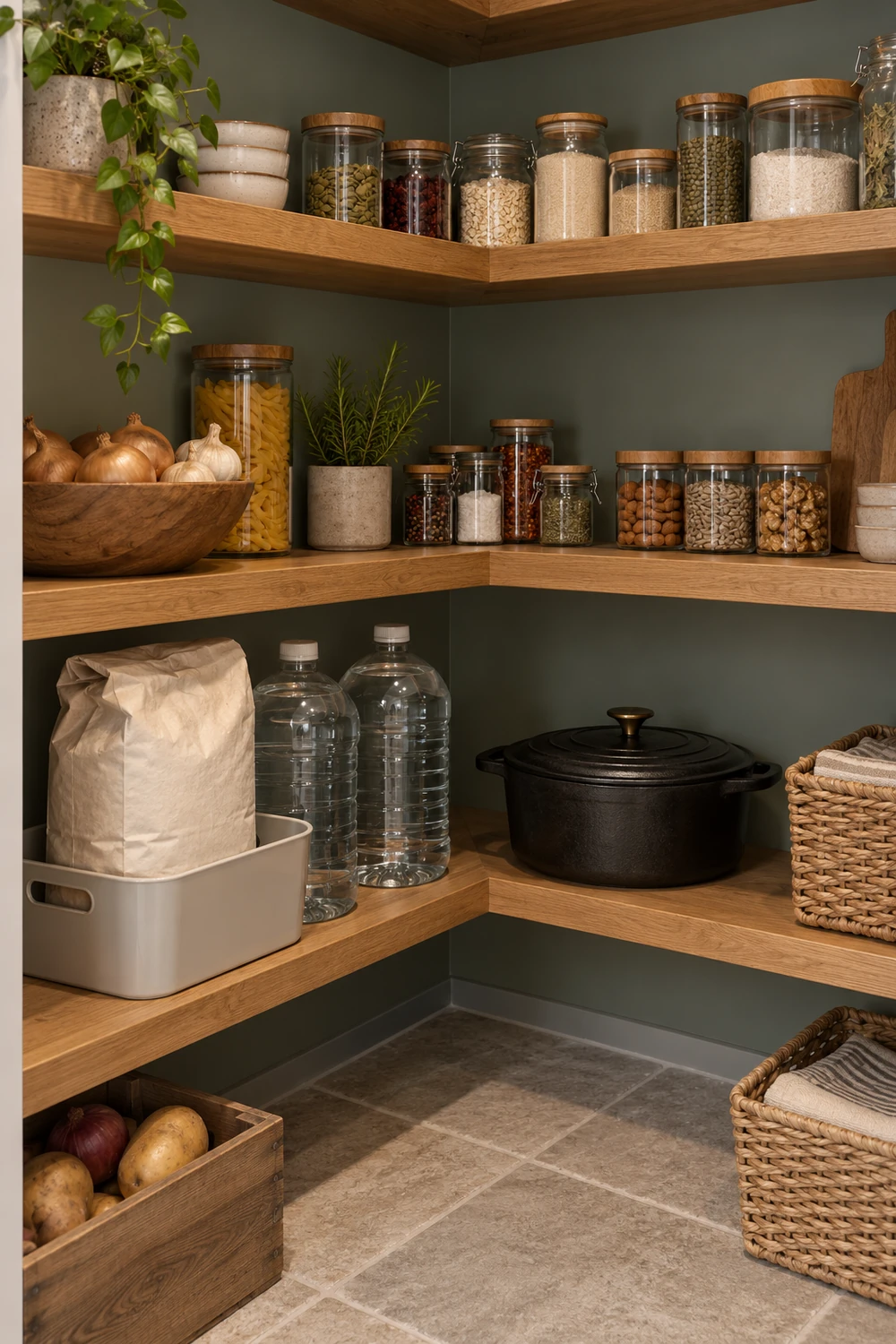
Lightweight paper goods and occasional reserves can use less convenient upper shelves. The pictured upper zone holds a modest amount, leaving the working shelves below for food used more often.
Group these reserves so their quantity remains visible. A basket of napkins or a few paper rolls is easier to review than several partly hidden packages spread behind everyday jars. Do not let the upper corner become a destination for anything without an assigned home.
Leave enough room to retrieve the group safely using appropriate access equipment when needed. Keep heavy jars and bulky cookware out of hard-to-reach overhead positions. Periodically bring older reserves forward and check what remains before shopping, so the corner stores useful household supplies rather than forgotten duplicates.

Preserve a sightline into the inside corner
An open view toward the junction makes the whole pantry easier to read. The example leaves enough separation between taller containers that the corner does not disappear behind a continuous wall of packages.

Stand where you normally select food and look toward both shelf runs. If the same jar disappears every time, move a taller neighbor or shorten the front group. Sometimes removing one container improves access to several others.
Corner pantry organization ideas should make use of the junction without treating empty space as a failure. A small gap can provide visibility, turning room and a place for your hand. Preserve that useful opening when returning groceries rather than filling it with the newest package simply because it is available.
Face handles toward the retrieval route
A handle only helps when you can reach it. The pictured wire bin faces outward, giving the hand a clear grip without pushing against the neighboring group. Its position supports the movement the bin needs to make.
Pull the container out slowly with its normal contents inside. Check that it clears the shelf edge, adjacent containers and the other arm of the corner. Do not assume an open-sided basket needs less clearance than a solid bin; projecting contents may catch even when the frame clears.
If a container must always sit at an angle to come out, consider a smaller footprint. The final position should be easy for another household member to understand and restore. A layout that relies on a precise hidden sequence is unlikely to stay organized.

Reset the corner and maintain the categories
The proposed finished pantry uses the existing L-shaped shelves with clearer groups and a more readable junction. Compare the ability to retrieve a jar or bin, rather than trying to match every container in the image.

During restocking, return each category to its shelf run and keep the corner’s movement space open. If a group regularly overflows, reduce the quantity or reassign its footprint. Do not solve it by quietly stacking another layer behind the junction.
Keep a short shopping note for categories that are nearly finished. Checking the corner before writing that list is especially helpful, since a hidden duplicate can make an otherwise organized shelf feel unexpectedly crowded after the next grocery trip.
For a straight shelf with hidden depth, use organizing a pantry with deep shelves. For doors, hinges and cabinet-height decisions, see organizing a pantry cabinet. Keep can rotation with the separate guide to organizing cans in a pantry. These corner pantry organizing ideas focus on the L-shaped meeting point, so each adjacent storage problem gets the attention it needs.