Bathroom / Bathroom Organization
Bathroom Drawer Organization Ideas for Everyday Essentials
A bathroom drawer should let you finish a familiar routine without searching under three unrelated things. The most useful bathroom drawer organization ideas begin with the products you actually reach for, then give those products containers that suit the drawer. A beautiful insert is only helpful if the drawer closes and your hand can reach every compartment.

Start with one drawer, a dry cloth and a place to sort its contents. You do not need to replace every organizer at once. Keep usable inserts and change the arrangement before buying anything new.
Start with what interrupts your routine
The mixed drawer below suggests a familiar problem: small objects disappear between larger packages. Before rearranging, notice which items you search for most often. A missing hair tie needs a small compartment; a bottle rolling into a brush needs a different kind of boundary.
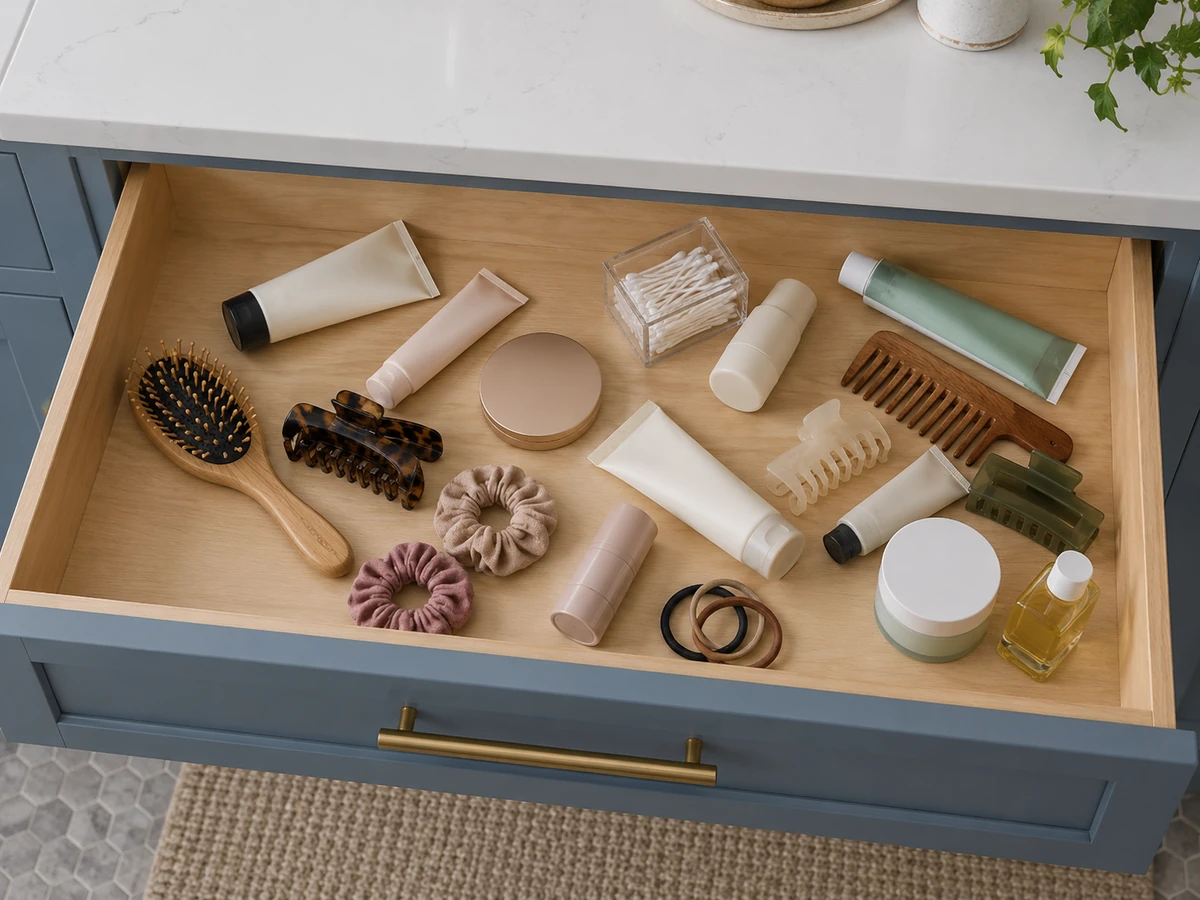
Empty the drawer completely and group its contents on a towel. Separate daily essentials, occasional tools, unopened backups and things that belong elsewhere. Remove packaging only when doing so will not discard directions, identification or storage information. Follow product labels when deciding whether the bathroom is a suitable storage location.
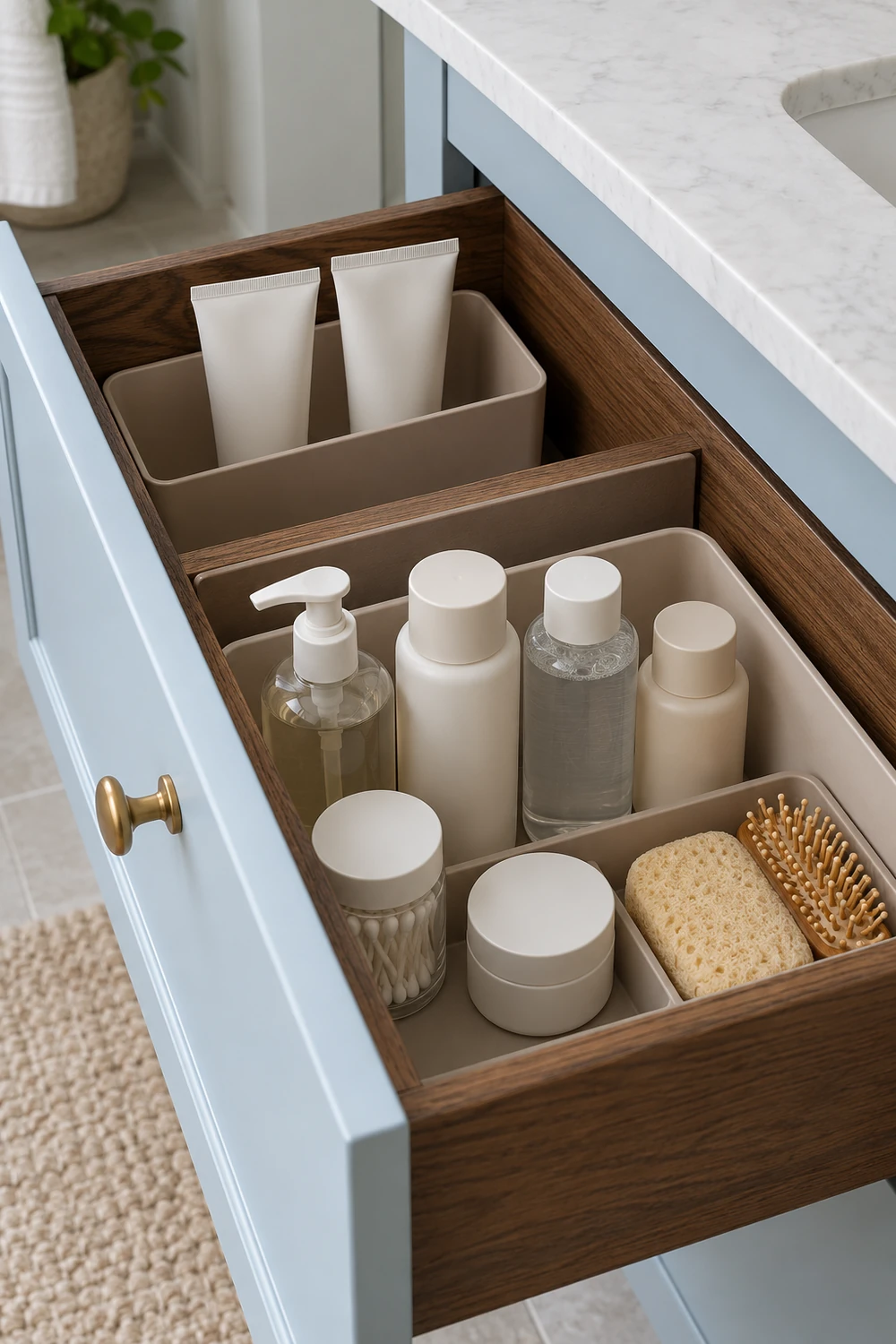
This starting view and the later reset present a proposed arrangement for the same blue drawer. Treat the comparison as a planning example, with the layout doing the work rather than a different cabinet.
Measure the usable interior before choosing inserts
Measure inside the drawer, rather than across the decorative front. Note width, front-to-back depth and usable height beneath anything above it. Open and close the drawer while watching the back edge: a tall bottle may stand inside yet catch on the cabinet when it moves.
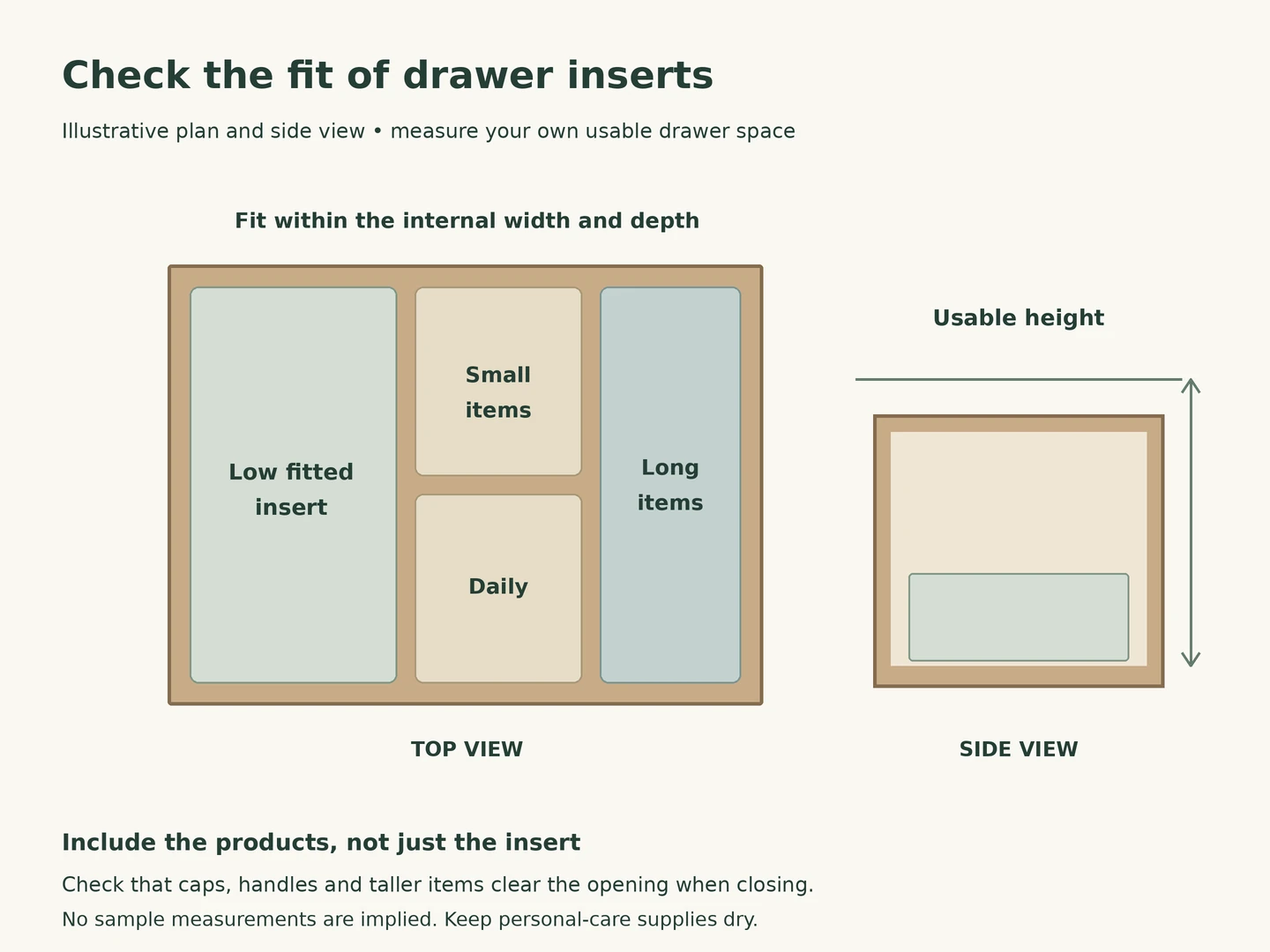
The diagram identifies the measurements to take; it does not provide dimensions for your own drawer. Make a simple paper template of the interior and mark awkward corners. Test containers with their lids attached, since a pump or cap often determines whether something fits.
For a deep drawer organizer bathroom shoppers can adapt to their own cabinet, prioritize stable sides and accessible contents over the biggest advertised capacity. Deep compartments need enough opening space to retrieve what sits at the bottom.
Keep shallow drawers deliberately flat
Shallow drawers work well for combs, small grooming tools and other items that can lie in a single layer. Use dividers to separate functions, but avoid dividing the space into so many tiny cells that longer objects no longer fit.
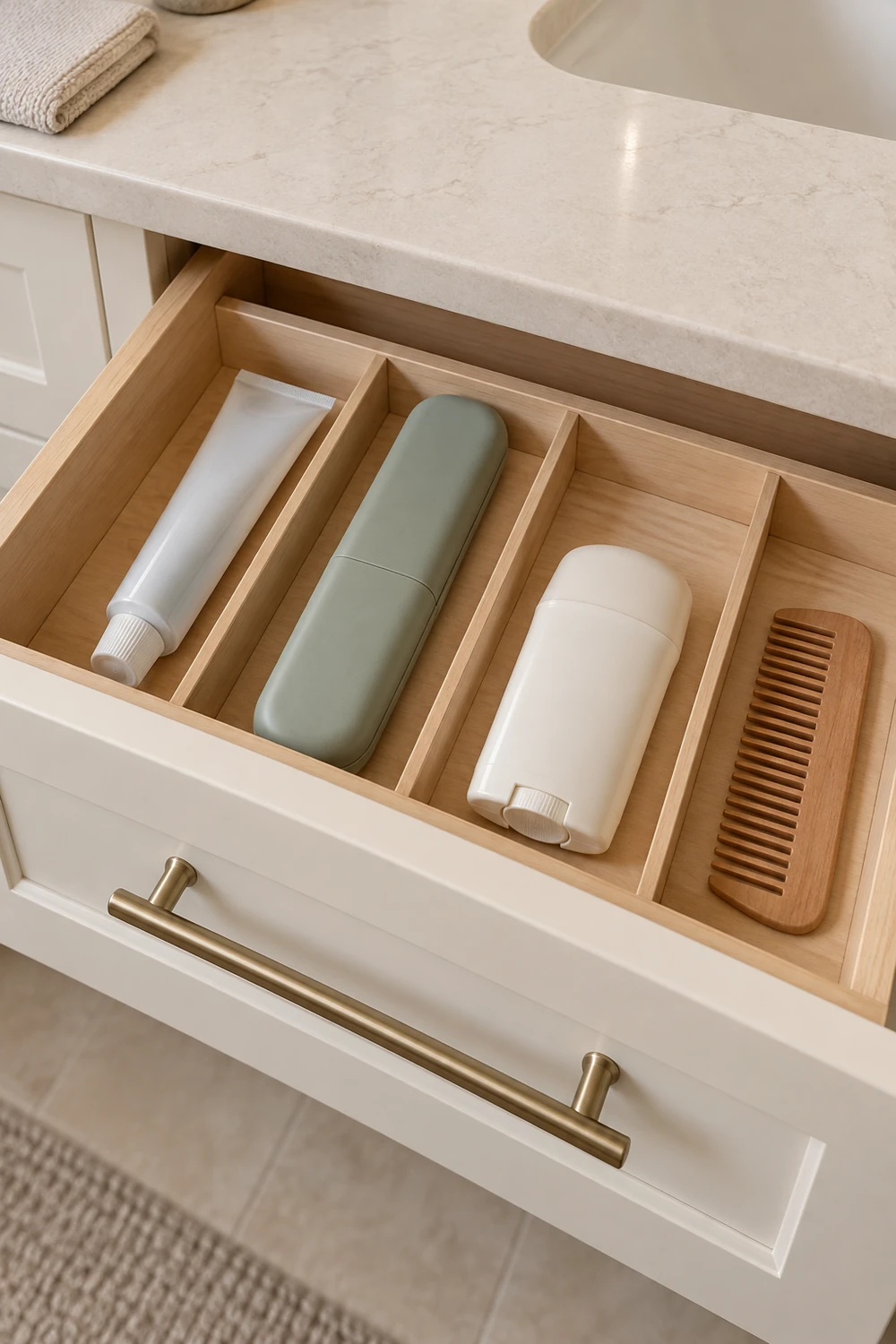
Place the most frequently used tool in a front compartment. Let longer pieces run along a side instead of diagonally across several categories. If an insert has rounded ends, test whether your actual items settle flat rather than sitting across the rim.
Leave a little space between objects. You should be able to grasp a comb without lifting everything beside it. A shallow drawer becomes easier to maintain when each compartment holds a recognizable group instead of an elaborate arrangement that must be rebuilt after every use.
Use height in deep drawers without building a pile
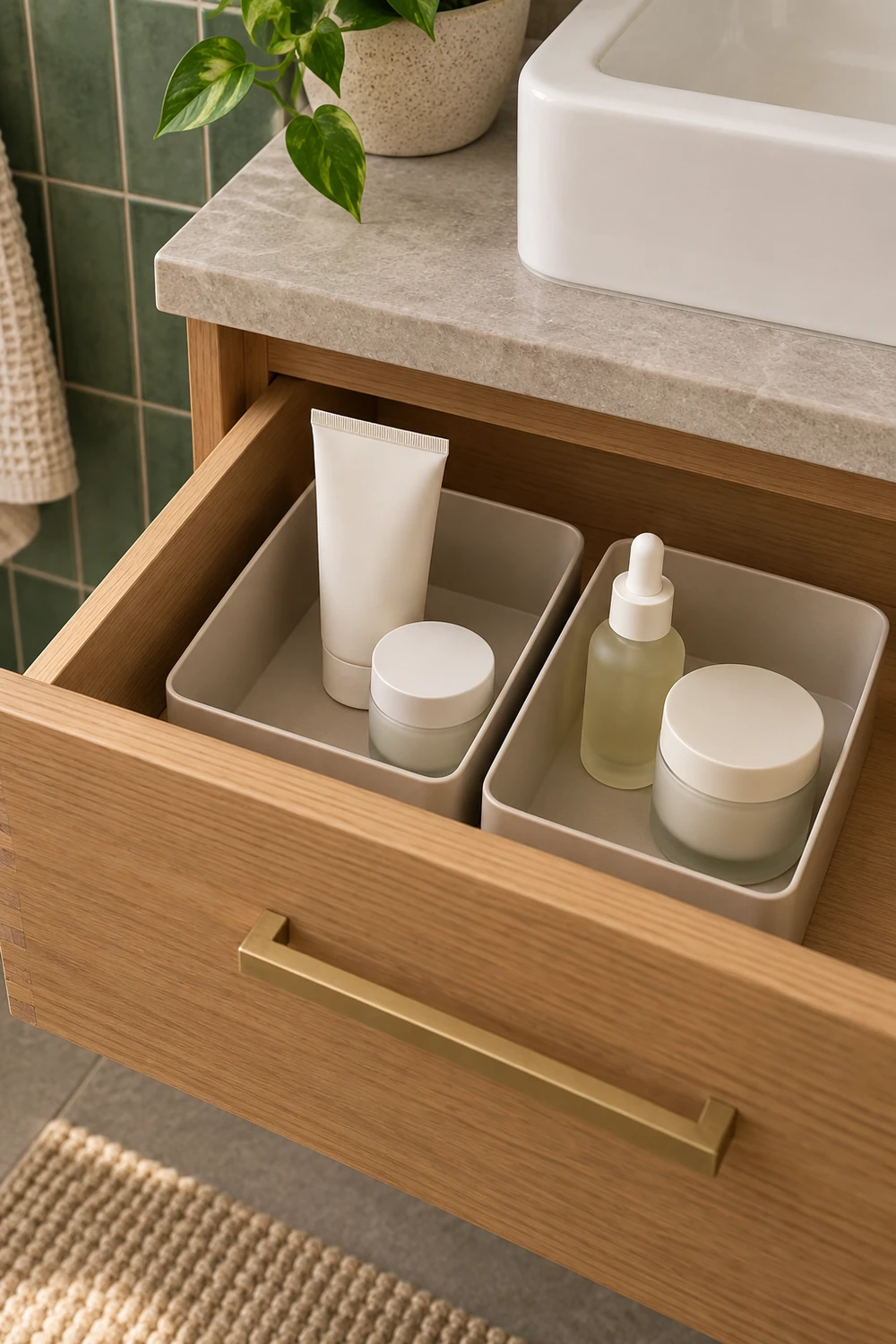
Upright skincare bottles can make a deep drawer easier to scan. Choose bins with a stable base and sides that keep bottles from falling across neighboring products. Group containers with compatible heights so short jars do not vanish behind tall pumps.

Test the drawer with a realistic load. A bin that sits neatly when empty may tip when several heavy bottles gather on one side. Keep caps closed and avoid storing containers at an angle merely to squeeze them below the cabinet.
If a product cannot stand upright with clearance, assign it another suitable location rather than forcing it into the drawer. The goal is a repeatable arrangement that works when products are nearly full as well as when they are almost empty.
Divide makeup by use, not by every possible category
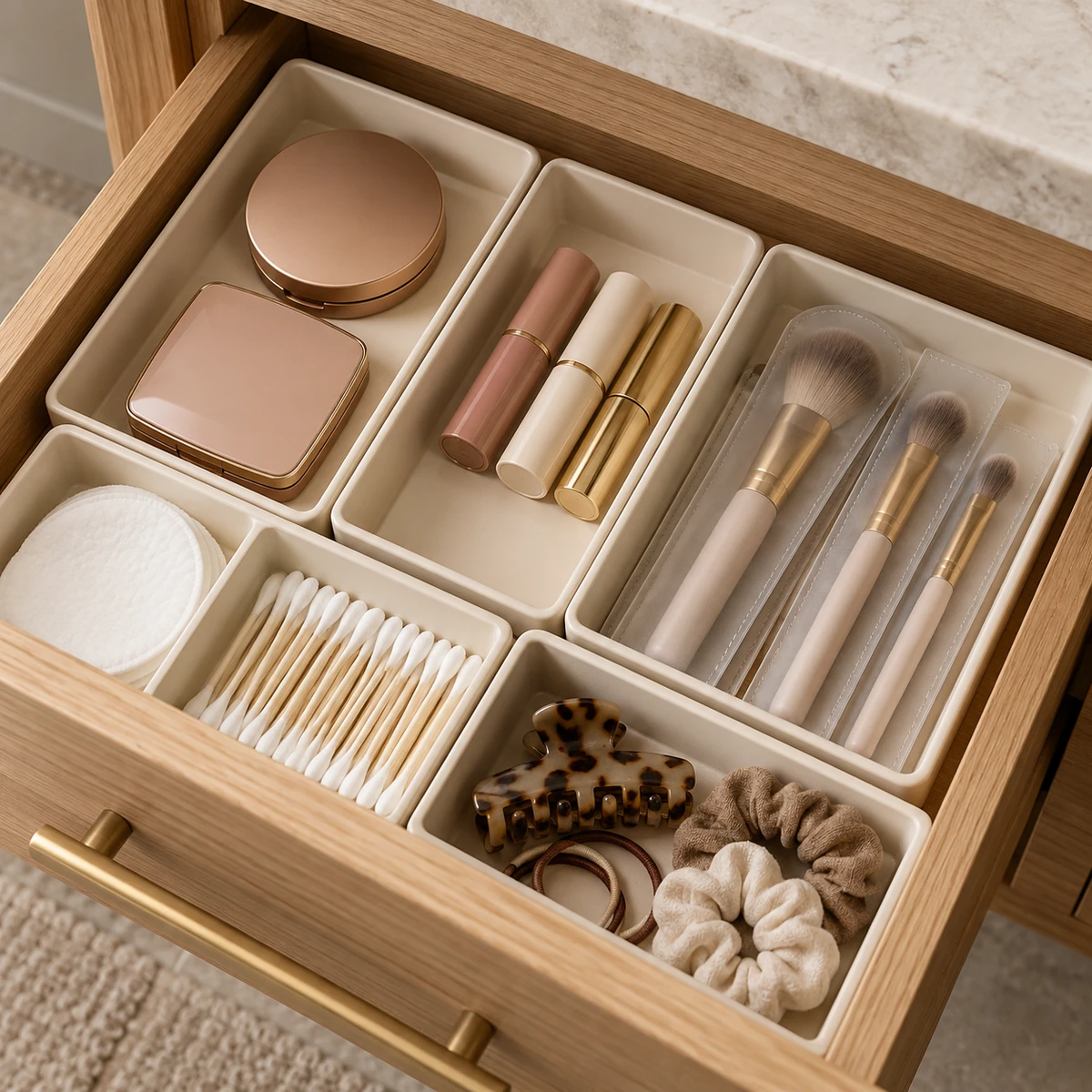
A compact makeup section can hold your regular face products, eye products and lip products without becoming a miniature display case. Keep the daily selection together and give occasional shades a separate container if you use them often enough to justify the space.
Arrange palettes so you can distinguish them without emptying the compartment. Store brushes in a way that protects their bristles and keeps clean tools away from product residue. Follow the care directions for the tools themselves.
Before adding another organizer, remove duplicates you do not use. A compartment overflowing with nearly identical products still takes time to search. Leave enough room for your current selection to change slightly, so finishing one product and opening its replacement does not require a complete drawer redesign.
Give tiny hair accessories a contained home
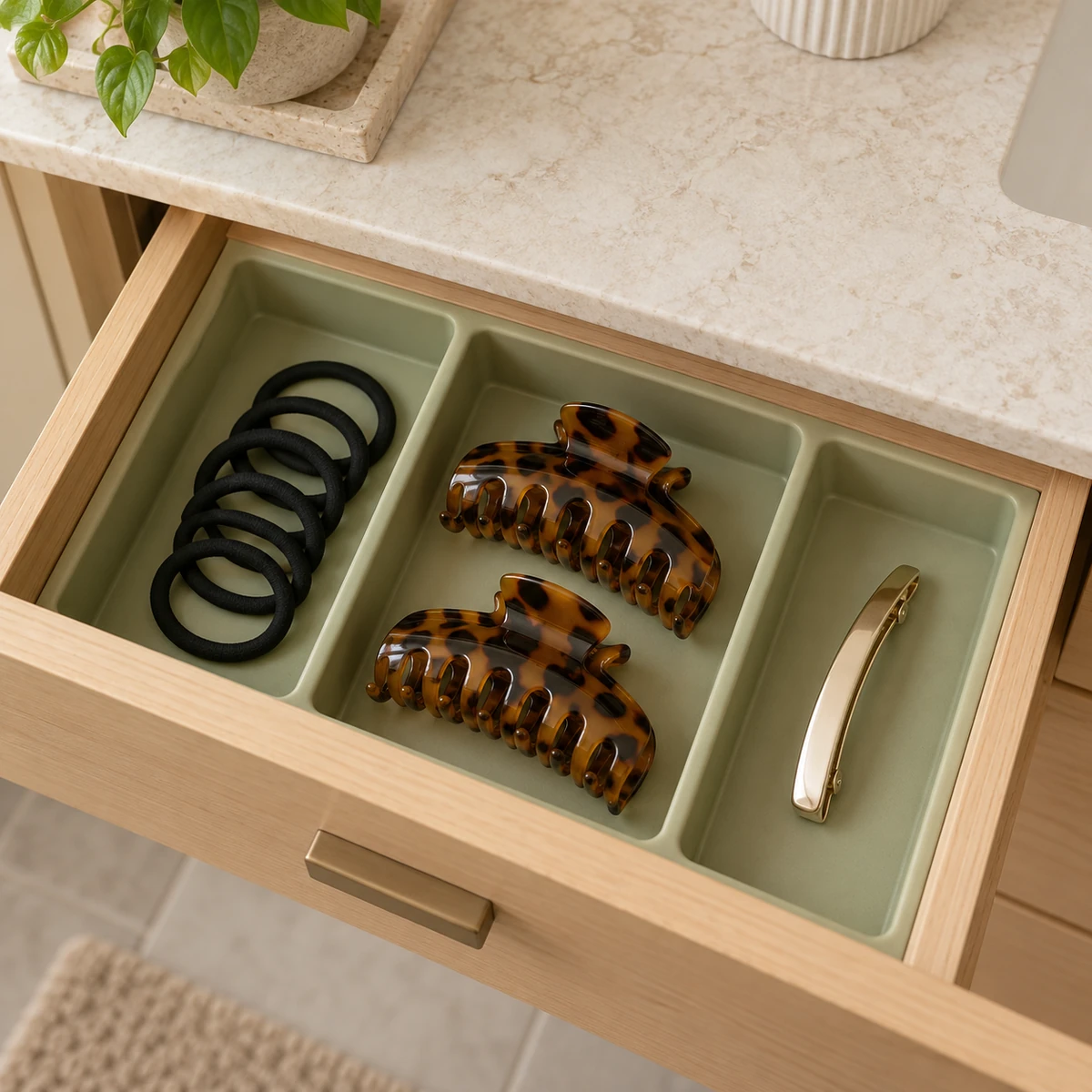
Elastics and clips need smaller boundaries than brushes or bottles. A little removable cup or divided section stops them from drifting under larger tools. Keep the accessories you wear regularly at the front, with occasional pieces together behind them.
Choose a container that lets you lift out an item without pinching against the drawer wall. An overly deep cup may hide small clips just as effectively as an unorganized drawer does. Spread a large collection across a shallow compartment when that gives better visibility.
Do a quick sort as accessories return from laundry or bags. Bent clips, broken fasteners and loose packaging do not need to remain in the daily section. Keep this drawer focused on usable items rather than every accessory you have ever owned.
Build morning and evening groups only when they help
Separate routine bins are useful when you use noticeably different products at different times. The two skincare groups shown here make each routine easy to lift out without disturbing the other.
Keep shared products in one obvious location between the groups or assign them a fixed compartment. Buying duplicate products solely to make two matching bins look full creates more storage work. Simple labels such as “Morning” and “Evening” help when several containers look alike, but they are optional when the contents are already clear.
Avoid treating the drawer as advice about how to use the products. Keep directions and product information available, and follow the manufacturer’s instructions. Organization should make your existing routine easier, rather than encourage unnecessary steps or additional purchases.
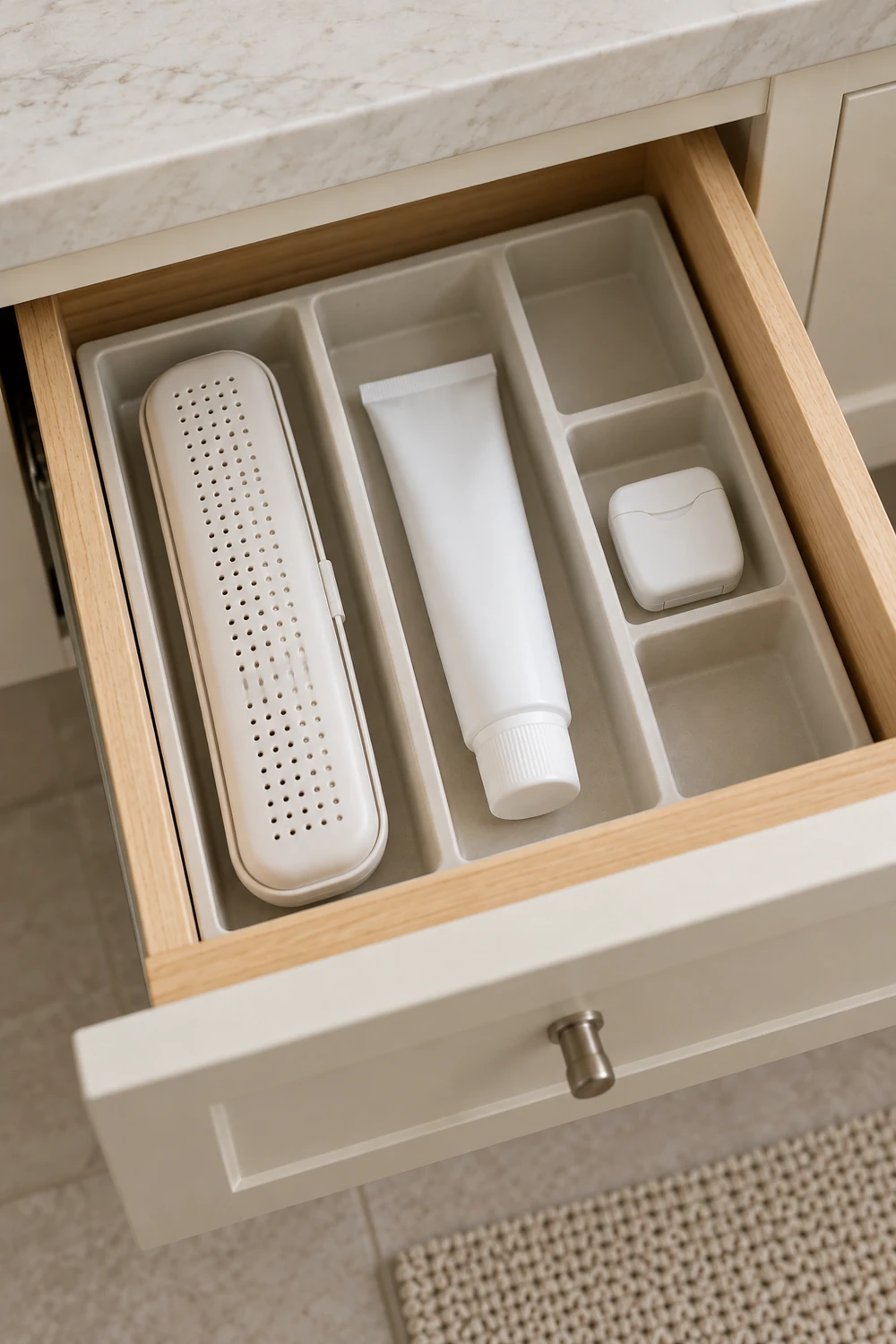
Protect spare dental supplies from loose items
Give dry, unused dental supplies a dedicated compartment. Keeping packaged replacements together makes it easier to see what you already have before buying more. Separate these supplies from leaky cosmetics, damp tools and loose accessories.
Do not use a closed drawer as a drying station for wet items. Let reusable tools dry according to their care instructions before returning them to storage. A small tray can contain the category without turning every item into a decanted display.
Keep only a sensible amount here. Large multipacks can occupy a separate household reserve location while one replacement stays near the daily routine. This distinction helps a bathroom drawer remain useful even when shopping habits occasionally bring home more supplies than the drawer can comfortably hold.
Make shared drawers fair and easy to read
In a shared bathroom, divide the drawer by person before subdividing every product type. Separate personal zones reduce the need to move somebody else’s things while getting ready. The pictured arrangement gives each user a clear area within one drawer.
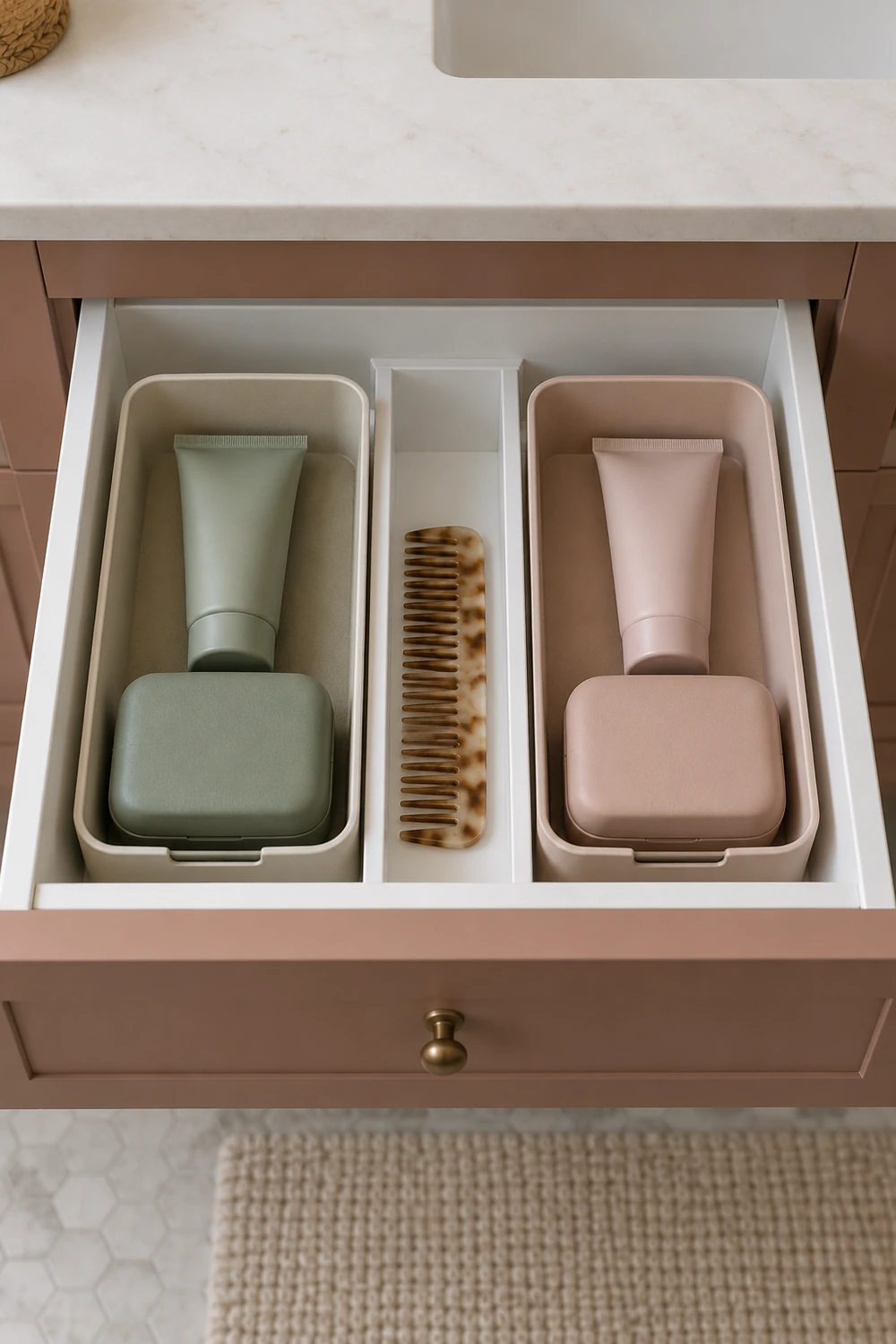
Agree on what belongs in the shared middle: perhaps spare cotton pads or a common grooming tool. Keep that section small so it does not expand into both personal areas. Different container shapes or discreet name labels can make the boundaries easier to follow.
Each person should be able to return an item with one movement. If the layout requires unpacking another person’s bin, adjust the arrangement. A shared drawer works best when its divisions reflect real routines, including different schedules and different amounts of equipment.
Edit small drawers before adding organizers
A narrow drawer may only hold the essentials for one routine. That can be more useful than trying to store a reduced version of every bathroom category. Choose the items you reach for most often and place the rest in a suitable secondary location.

Use the drawer’s full length for a longer brush or tool, then contain the smaller pieces beside it. Avoid a bulky organizer whose thick outer walls consume most of the available width. Sometimes two simple trays outperform one fitted insert.
Try the layout for several mornings before deciding it needs more storage. If you regularly retrieve something from elsewhere, it may deserve a place here. If an item remains untouched, let its space go to something that supports the routine you actually follow.
Choose inserts you can remove and clean
Removable inserts let you deal with dust, loose powder and small spills without dismantling a permanent divider system. Look for smooth surfaces and accessible corners, then follow the organizer’s cleaning instructions rather than assuming every material can be soaked.
Take containers out before wiping the drawer, and let both the drawer and inserts dry before replacing them. If products frequently leave residue, inspect their closures and consider a washable tray beneath that category. The organizer should contain normal use, not hide a recurring leak.
A little extra clearance around inserts also makes lifting them easier. Avoid wedging them so tightly that removing one scratches the cabinet or requires pulling on the drawer hardware. Ease of cleaning matters as much as how tidy the layout looks on its first day.
Reset the blue drawer around clear categories
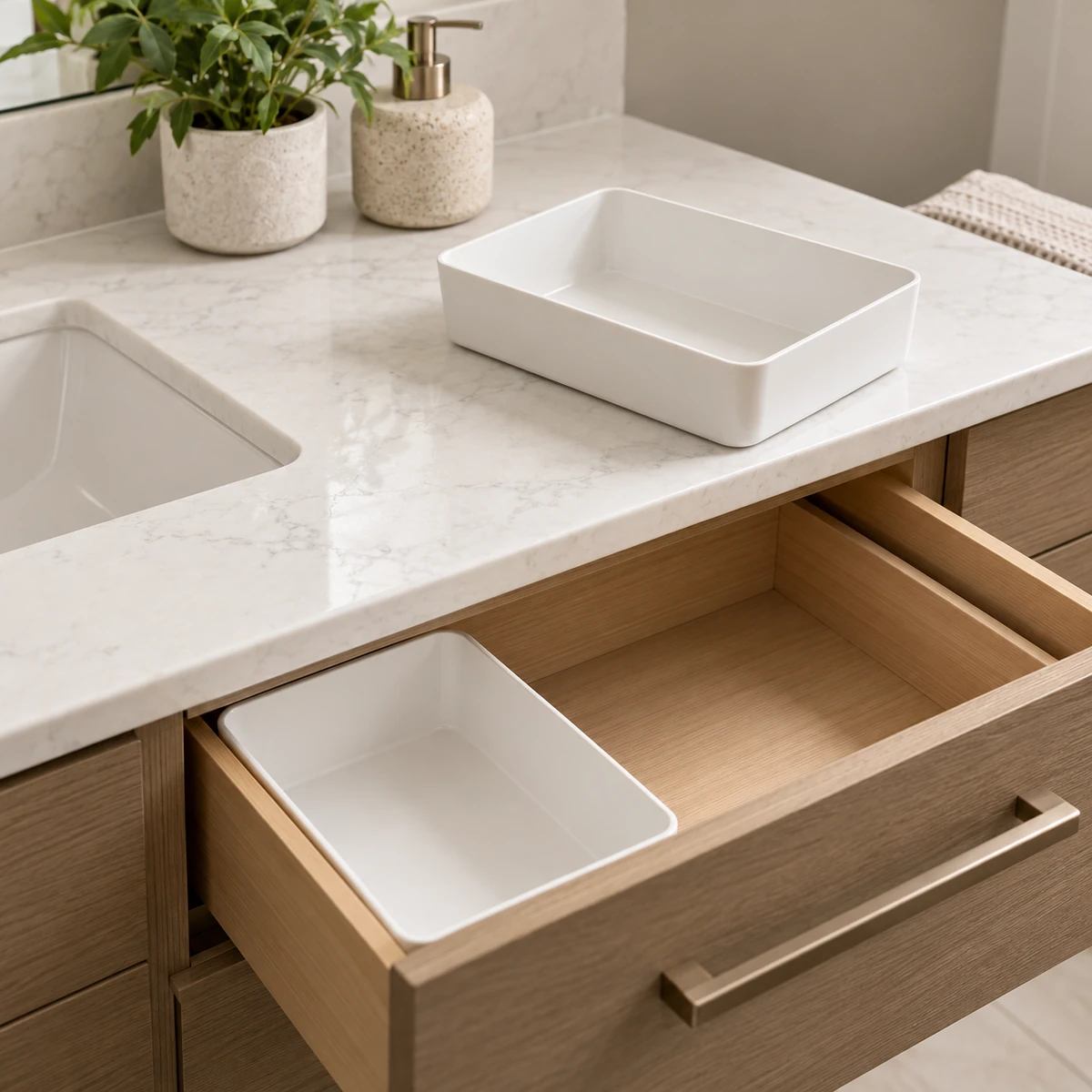
The proposed reset keeps the same drawer while giving daily items defined spaces. Notice how the dividers prevent one category from spreading across the whole interior. The useful change is that each item has somewhere obvious to return.
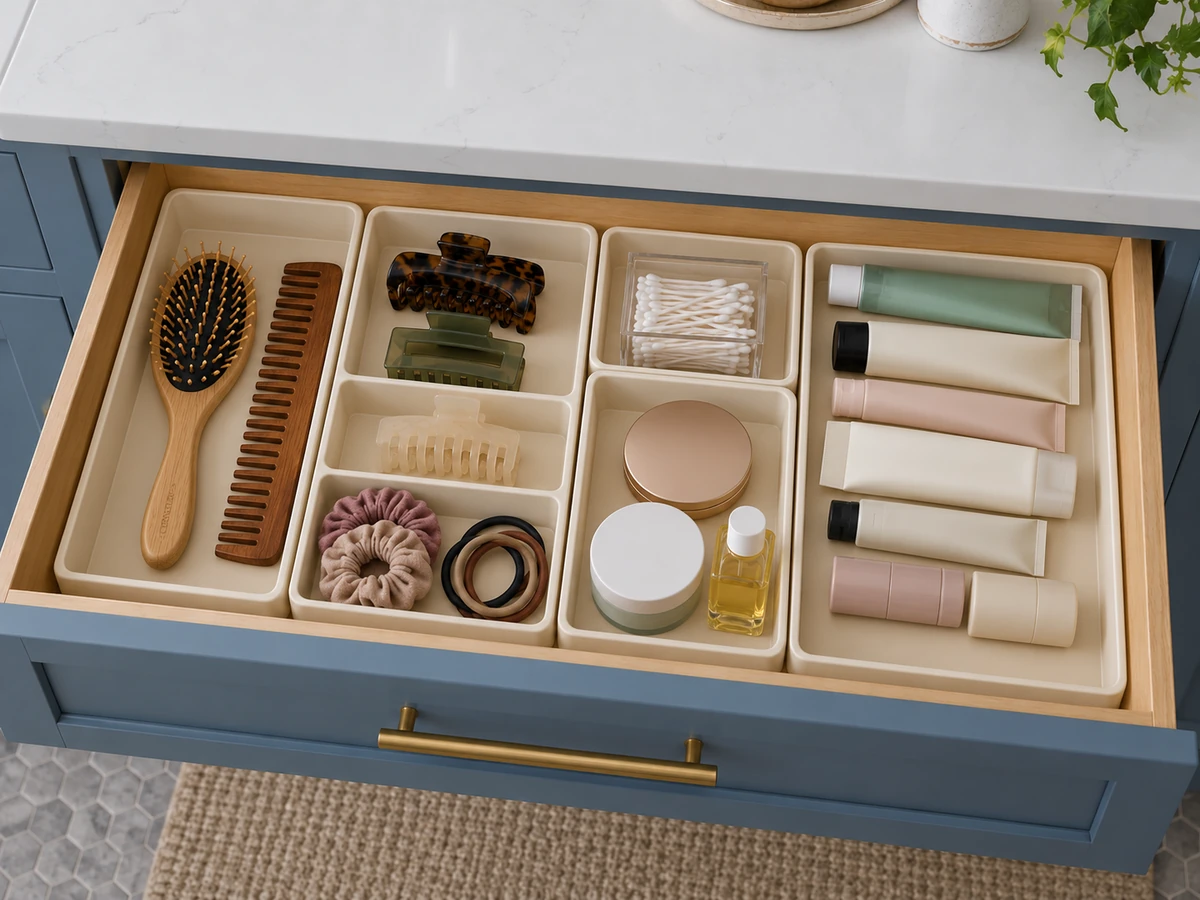
Recreate the principle with your own contents rather than copying the pictured quantities. Close the drawer, reopen it and retrieve your three most-used items. If any requires moving another category, simplify that area. Check that the inserts stay put during normal movement.
You do not need every compartment filled. Empty space allows a hand to reach in and leaves room for ordinary changes in packaging. The finished drawer should stay comfortable to use when you are hurried, not only when everything has been arranged carefully for a photograph.
Keep backups separate from the daily selection
A limited reserve section can hold the next replacement without burying current products. Put the active item in its daily zone and the unopened replacement in a clearly separate space. Refill the daily section from this reserve before purchasing more.
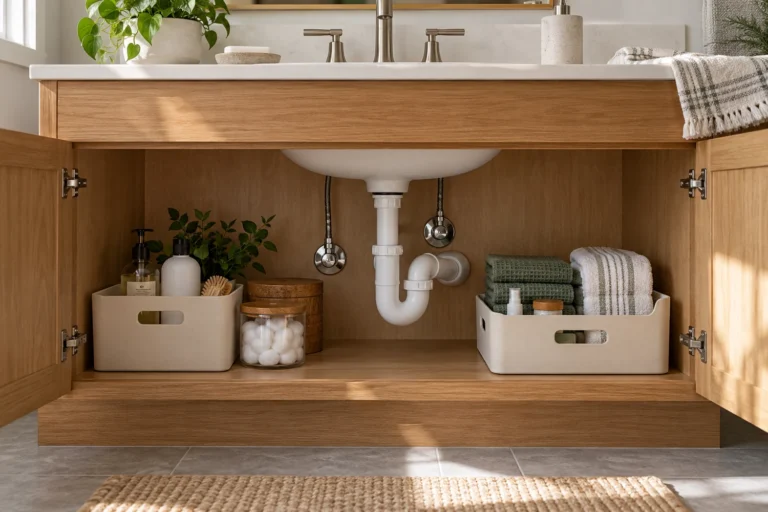
For larger household overflow, use the broader shelf plan in organizing a linen closet. Keep towels with bathroom towel storage and pipe-adjacent supplies with under-bathroom-sink organization, rather than asking the drawer to solve every storage problem.
Once a week, return loose items to their compartments and note anything nearly finished. If a category repeatedly overflows, reduce the quantity or change its assigned space. That small adjustment keeps the drawer useful without requiring another complete organizing session.