Entryway / Entryway Rugs
Entryway Rug Ideas for Different Doorways and Layouts
An entry rug can give the arrival area a clear shape, connect it to the room, and make a long hallway feel more considered. But a beautiful pattern cannot compensate for a door that catches the edge or a runner that shifts whenever someone comes home.

The most useful entryway rug ideas begin with the doorway and walking route. Choose a shape that suits the space, test the complete rug and backing beneath the door, and keep the edges flat and stable. Then consider color, texture, and the cleaning routine the entrance needs.
Start with fit rather than a standard rug size. The right choice belongs to your actual entrance, not simply to a room labeled small, modern, or traditional.
Map the Door Swing Before Choosing a Rug
Open the entrance door through its full normal movement and look at the floor it passes over. Include any sweep or weather seal beneath it.
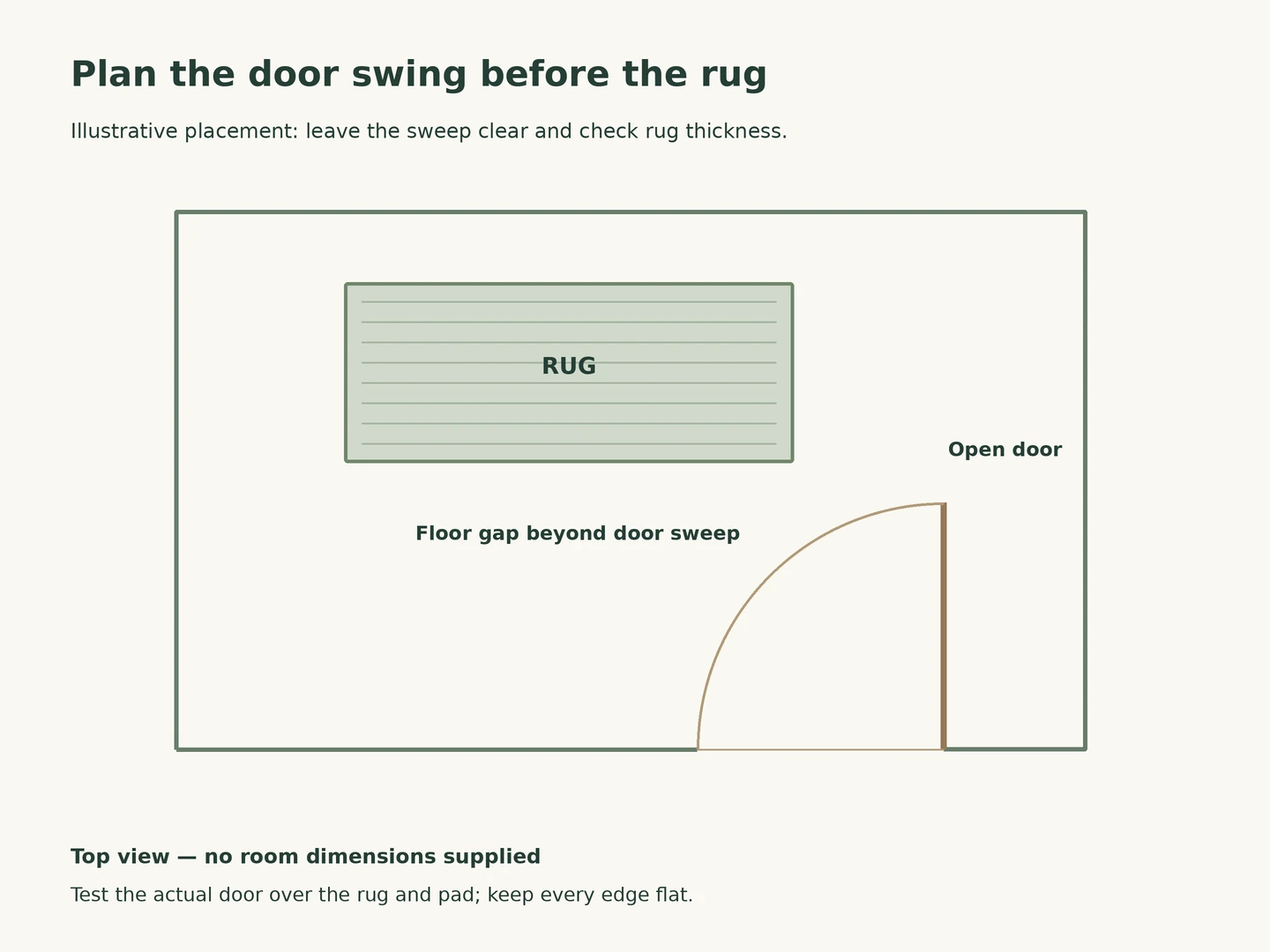
The diagram places a rug beyond the door sweep as one possible approach. It illustrates layout relationships rather than supplying room dimensions or a universal clearance gap.
Measure the available floor area and test a paper outline of the proposed rug. Check the entrance route, neighboring doors, and any change in floor level.
If the rug will sit beneath an opening door, test the actual combined thickness of rug and suitable backing. A product described as low pile may still be too thick for a particular door.
Avoid altering a door, sweep, or threshold simply to fit a decorative rug without appropriate professional advice. Choosing a different rug or position may be the simpler solution.
Choose Shape According to the Entrance Footprint
| Entrance layout | Shape to test | Main placement check |
|---|---|---|
| Compact arrival area | Small rectangle | Fits beyond or beneath the door movement appropriately |
| Long hallway | Runner | Follows the route without awkward edge positions |
| Square foyer | Round or proportionate rectangle | Relates to the usable open area |
| Wide double doorway | Broader rectangular rug | Connects to the full opening and normal arrival path |
| Narrow corridor | Slim low-profile runner | Preserves clear, stable edges along the route |
These are starting points, not compulsory pairings. Test the shape against furniture and movement before choosing the final dimensions.
Use a Compact Rectangle in a Small Entrance
Small entryway rug ideas work best when the rug defines the arrival area without filling every available inch. A visible floor border can help the outline remain clear.
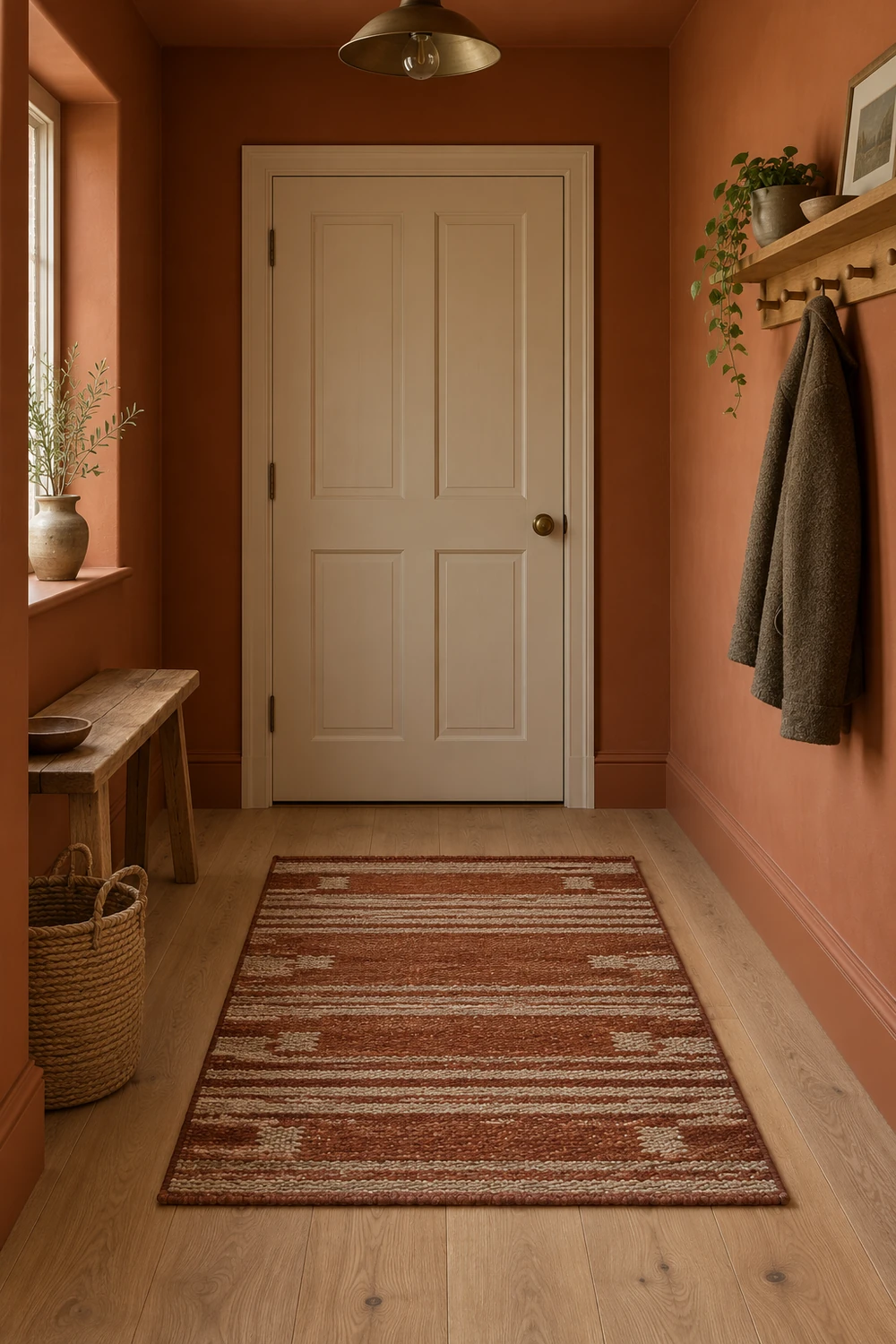
The rust rectangle relates to the compact terracotta entrance while leaving oak floor visible around it. Its scale is tied to the useful floor space rather than the width of the entire wall.
Check where both feet land when someone enters and turns. An undersized rug can put its edge exactly where that turn happens, while an oversized one may interfere with doors or storage.
Use a template before buying, then test the actual rug in place. The thickness, flexibility, and edge finish also affect how the rug behaves in everyday use.
Follow a Long Hallway With a Runner
A runner can reinforce the main direction of a long entrance and connect several parts of the route. Its ends deserve as much attention as its overall length.
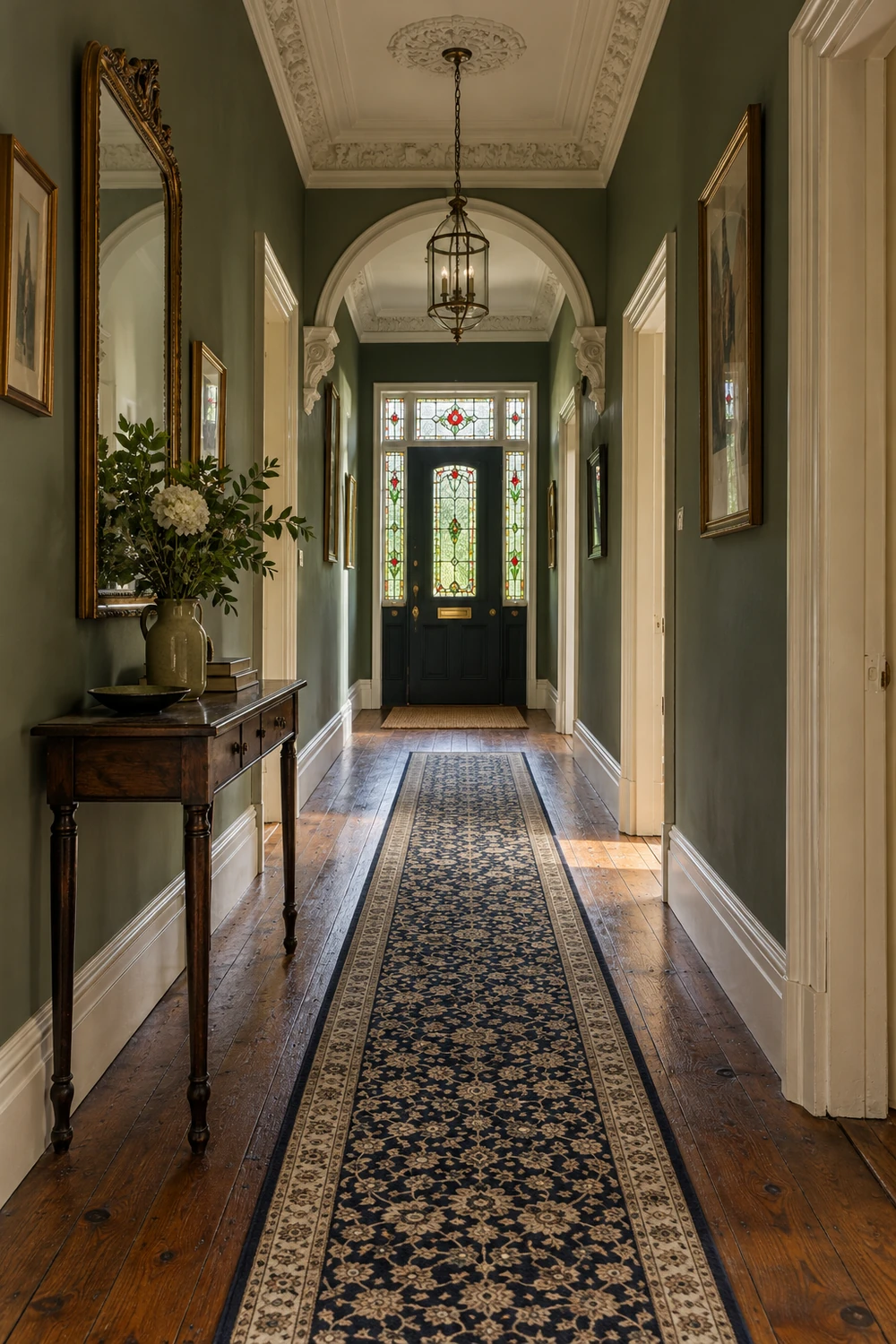
The navy runner follows the green hallway toward the front door. The surrounding floor keeps the route legible and lets the pattern form a coherent line.
Check where the runner starts and ends relative to doorways, turns, and nearby rooms. Avoid positioning an unsecured edge in a place where people regularly pivot or step sideways.
A longer runner is not automatically better. Choose a length that suits the actual stretch of circulation and can be maintained without difficult lifting or furniture movement.
Try a Round Rug in a Square Foyer
A round rug can give a square arrival area a defined center without repeating every straight architectural line. It needs enough usable floor around its whole circumference.
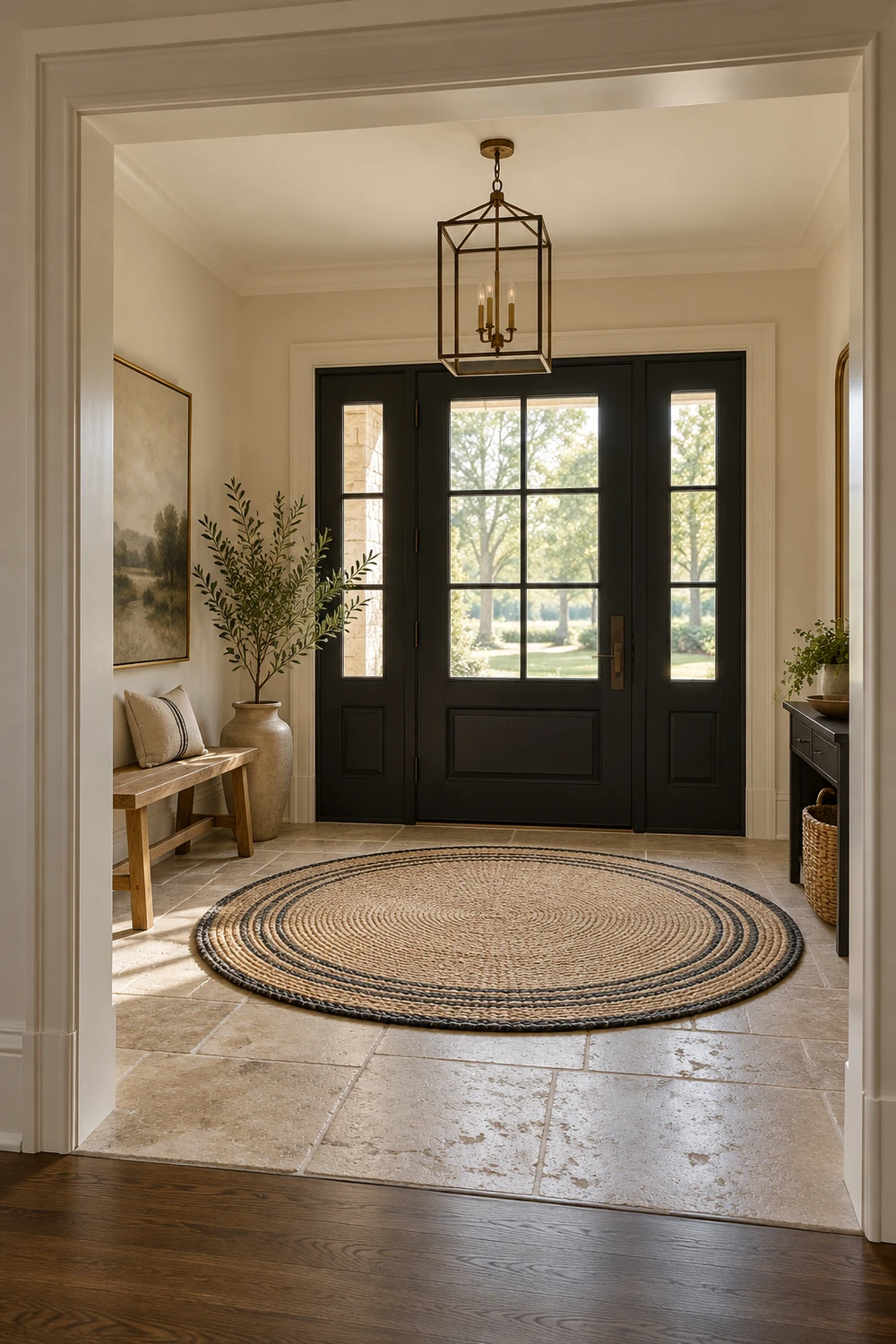
The braided circle sits within a clear stone border. The curved edge feels deliberate because it has room to read as a complete shape.
Measure the diameter against the door swing and nearby furniture. A circular rug can fit between walls yet still place an edge awkwardly across the route.
Check the actual walking pattern rather than centering it mechanically in the room. A slightly different position may better support the movement from the door into the house.
Relate a Wide Rug to Double Doors
A wider entrance can make a small mat look isolated. Consider the full door opening and the way people move through it before choosing a broader rug.

The blue rug connects to the pair of mahogany doors rather than sitting in front of only one narrow section. The exposed stone around it keeps the outline clear.
Test both doors if both are used. Include their sweeps and any threshold transition in the clearance check.
Do not choose width solely for appearance. The rug still needs a stable position, flat edges, and a cleaning routine suited to its size. A broad decorative surface should make arrival feel simpler, not introduce another awkward layer at the threshold.
Keep a Narrow Runner Low and Clearly Defined
In a narrow entrance, a runner’s profile and edges can matter more than a bold pattern. Choose a rug that lies appropriately flat on the actual floor.

The thin olive runner keeps a restrained outline within the pale entrance. Its edges remain visible rather than disappearing beneath several pieces of furniture.
Check the full walking route, including where people step around a bench or storage unit. Avoid relying on a narrow strip of bare floor beside the runner if that strip is not the route anyone naturally uses.
Keep the backing suitable to the rug and floor. Low profile does not automatically mean secure placement, so test movement as well as height.
Test Door Clearance With the Complete Rug Setup
Place the rug and its intended support in position, then move the door slowly through the full range. Check more than the moment when the door first reaches the rug.
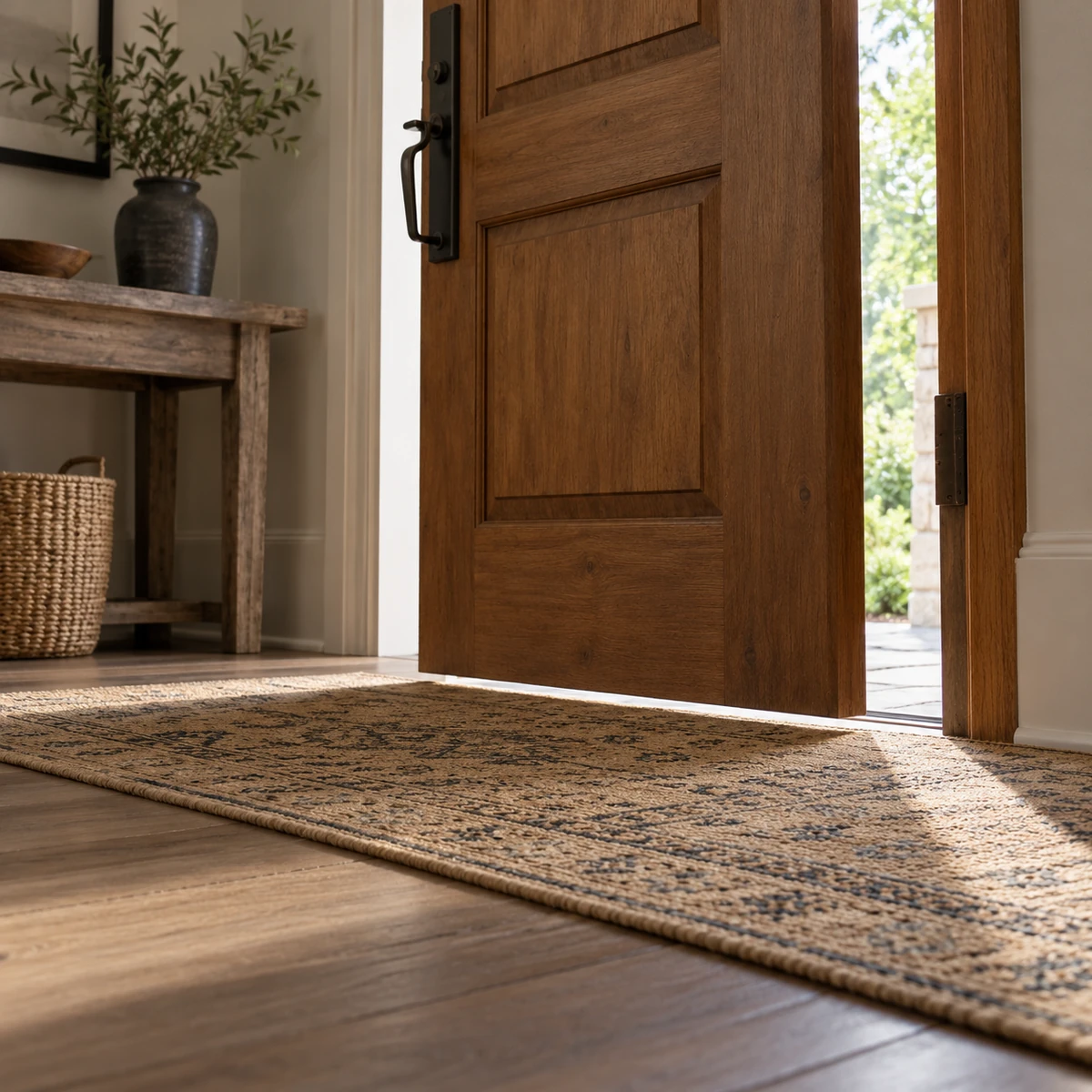
The detail shows a visible gap above the low rug. Your own clearance must be checked with the actual door, floor, backing, and rug edge.
Stop if the door bunches or drags the rug. Do not assume the problem will disappear after the rug settles.
Repeat the check after cleaning or repositioning. A rug that shifts forward can create a different relationship with the door than the one you first tested.
Keep the Rug Stable and the Edges Flat
A suitable non-slip support may help a compatible rug remain in place. Check the rug and flooring manufacturers’ guidance before choosing the material.
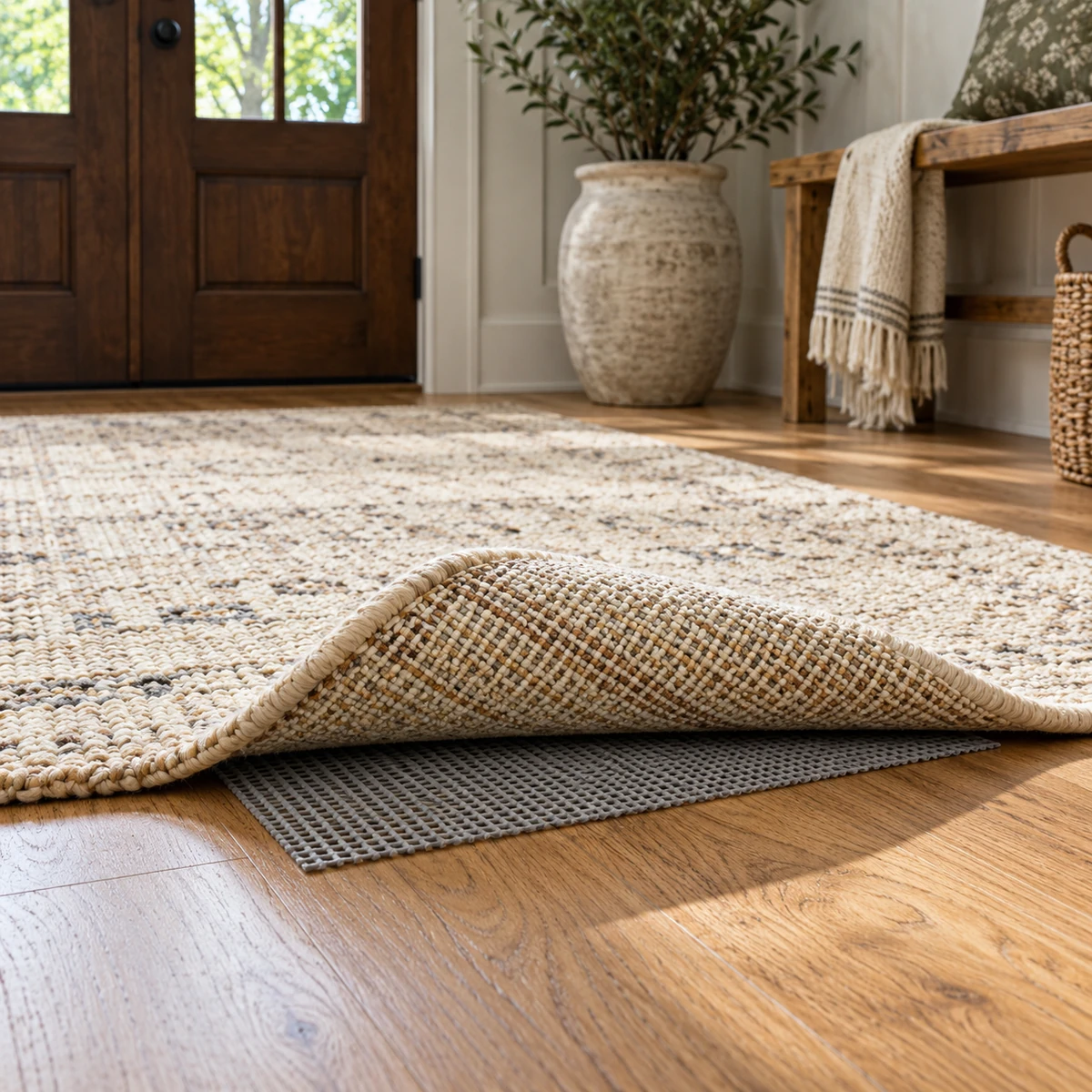
The mesh pad is inset beneath the rug rather than extending beyond its edges. Use the actual product instructions to size and position your own support.
The CDC’s home fall-prevention checklist advises removing loose rugs or securing them so they do not slip. If a rug cannot remain stable and flat, leaving it out can be the better choice.
Inspect corners, folds, and edges regularly. A pad does not correct every problem, and a rug that curls or bunches needs attention rather than another decorative layer above it.
Use Geometry for a Modern Entrance
For entryway rug ideas, modern patterns can introduce structure without a complicated palette. A restrained geometric design may connect to simple doors, a bench, or clean-lined furniture.
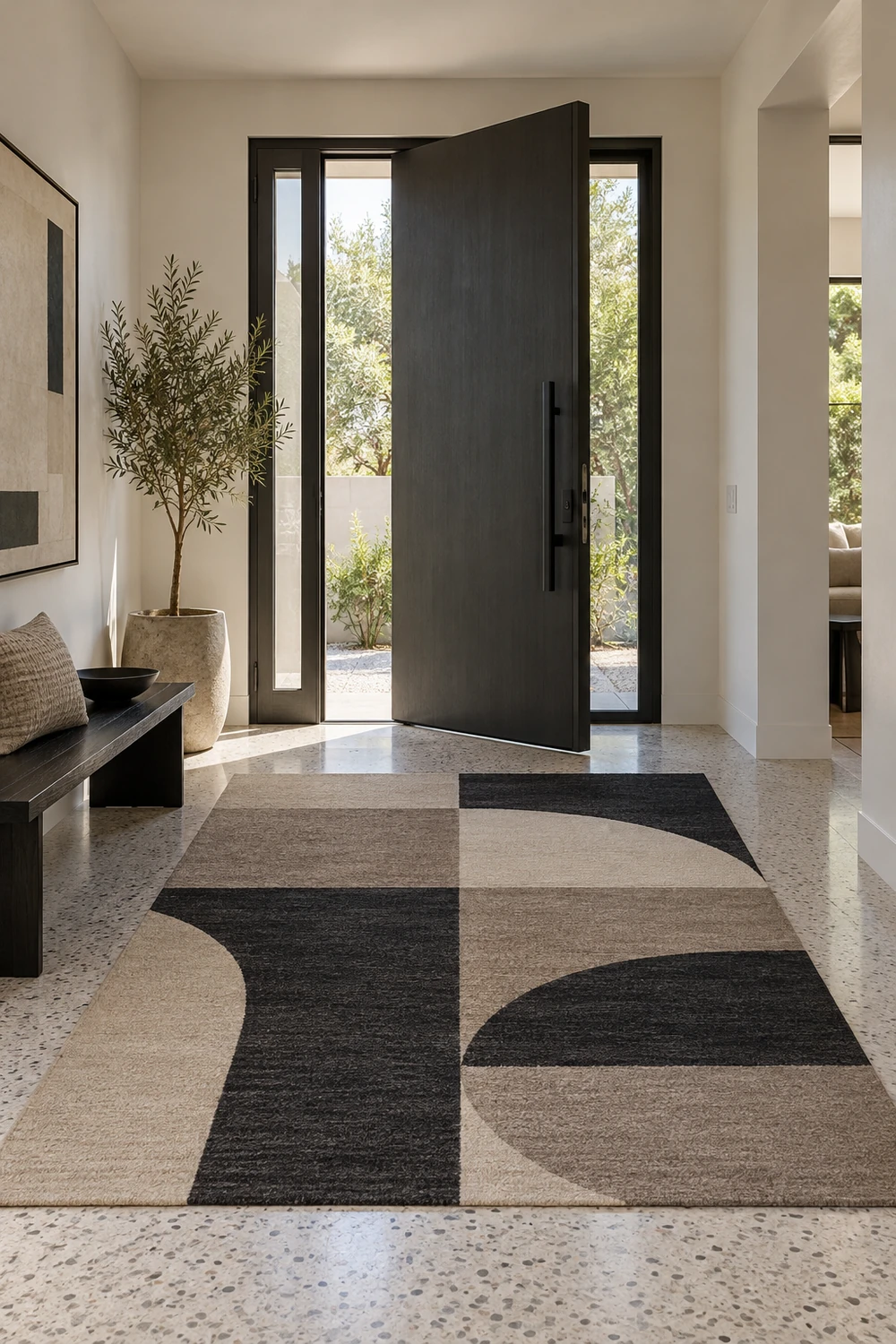
The taupe-and-black pattern creates a distinct shape in the terrazzo entrance. Its scale allows the pattern to read from the doorway rather than becoming a collection of tiny marks.
Look at the floor pattern too. If the tile or stone is already busy, a quieter rug may give the room more clarity.
Choose the design after confirming fit and stability. A graphic pattern can make an unsuitable edge more noticeable, but it cannot make a poorly placed rug function better.
Connect a Faded Pattern to Traditional Materials
A faded or softly varied pattern can relate to wood furniture and existing room colors without making the entrance feel like a matched set.
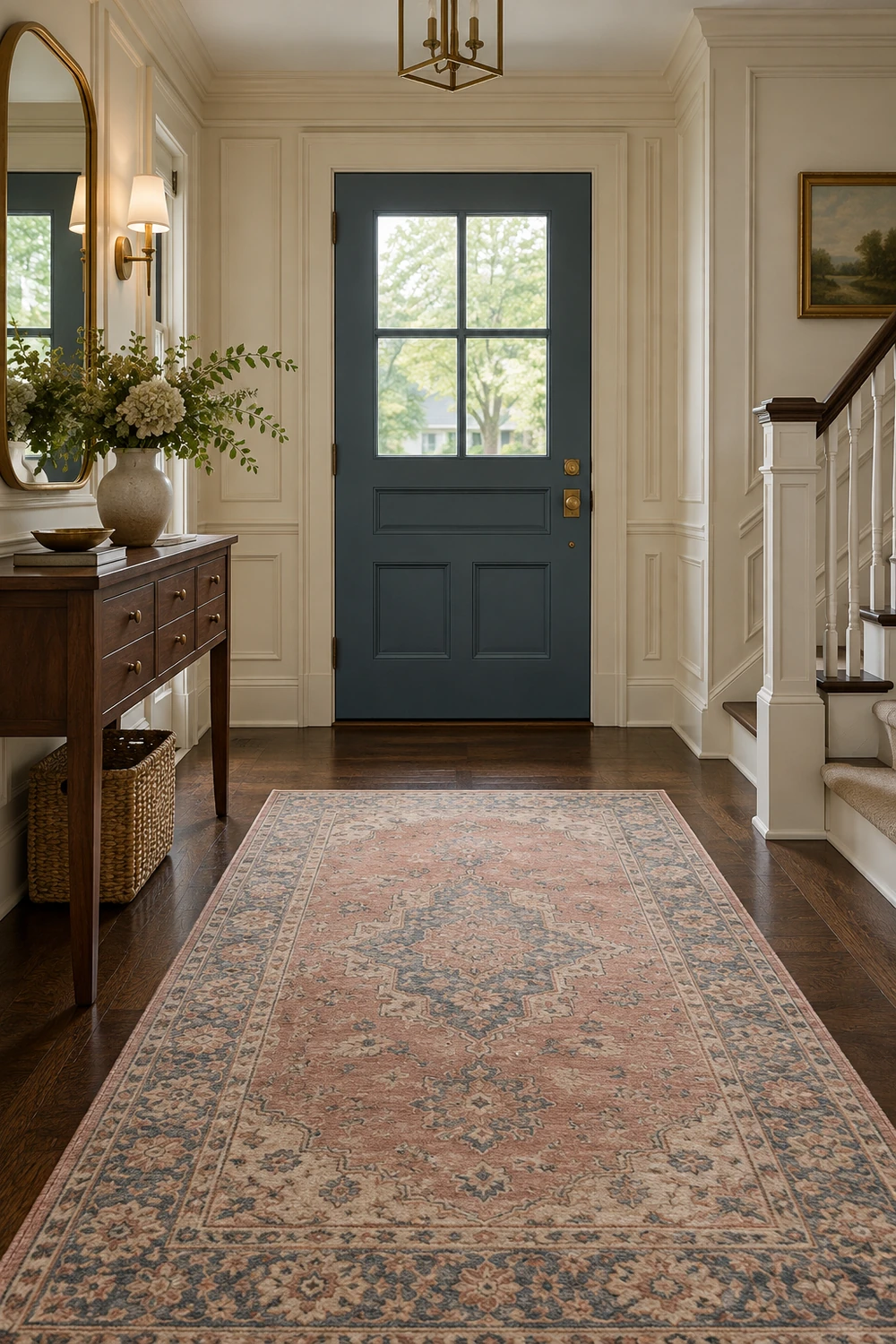
The rose-and-blue rug sits beside a cherry console, connecting the furniture’s warmth to a softer floor pattern.
Choose one or two colors to repeat rather than trying to reproduce every shade elsewhere. A lamp base, artwork detail, or existing textile can provide enough connection.
Check the pattern in daylight and after sunset. Subtle differences may become much quieter under evening light, while a strong border may remain prominent.
Choose Woven Texture for the Actual Conditions
A natural-looking woven surface can add warmth, particularly against tile or stone. Its practical suitability depends on the exact material and care requirements.

The bound rug provides a clear textural area on terracotta tiles. The visible border gives the weave a finished outline.
Check whether the product suits the entrance’s moisture and cleaning conditions. Do not assume every woven or natural-fiber rug tolerates damp shoes or frequent washing.
Test the texture under ordinary footwear and consider the needs of everyone using the route. Choose comfort and maintainability alongside the visual effect.
Use a Darker Pattern Without Skipping the Cleaning Plan
A darker patterned rug can suit a busy entrance, but visual camouflage is not a substitute for removing dirt and moisture.
The dark pattern sits beside a family coat-and-shoe area. Keep the storage footprint separate from the rug’s normal walking surface.
Plan where footwear will land before stepping farther into the room. Our entryway shoe storage ideas compare trays, racks, benches, and cabinets for that distinct task.
Choose a rug you can care for at the frequency the household needs. A pattern that suits the room should still be easy enough to inspect and maintain.
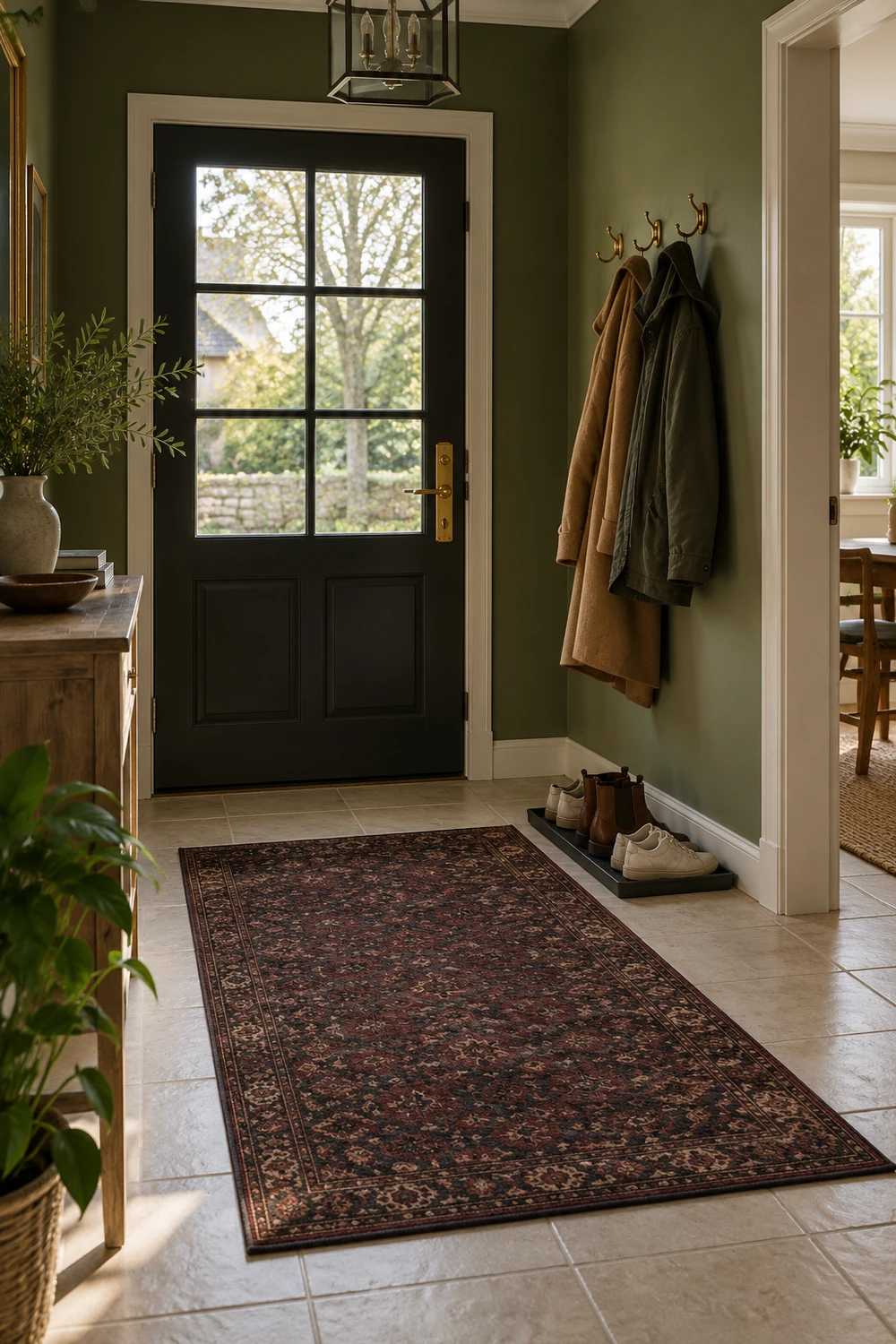
Check the Relationship to Console Feet
Entry furniture and rug placement should work together without leaving the furniture unstable or the rug difficult to remove.

In this example, the rug sits forward of the console, whose feet remain on bare oak floor. This keeps the furniture separate from the rug’s footprint.
Other arrangements may work, but test the actual furniture and floor. Avoid a position where one foot sits on an uneven edge or where the rug cannot be cleaned without a difficult move.
Keep drawers, baskets, and the space to stand in front available. A rug should support the route through the entrance rather than become another object to work around.
End the Rug Deliberately at a Room Transition
A change from one flooring material to another can provide a natural place for the entrance rug to stop. Check the edge and floor level rather than treating the transition as only a visual line.
The teal rug ends before the slate-to-wood transition. This makes the entrance zone distinct without extending the rug awkwardly into the adjoining space.
Look from both rooms and walk the route in both directions. Keep the rug flat and the change in surface easy to see.
Our entryway lighting ideas cover useful illumination along this route. For the wall above or beside the floor arrangement, entryway wall decor ideas address a separate styling task.

Choose a Rug You Can Lift and Clean Appropriately
The cleaning routine should be part of the selection. Check the care label, loaded weight when relevant, and any machine requirements for a rug described as washable.
The lightweight example rolls back to reveal the tile beneath. That access makes it possible to inspect the floor and support rather than cleaning only the visible top.
Follow the rug, pad, and flooring instructions and let components dry appropriately before returning them. Recheck the edges and door movement after replacing the rug.
Do not assume a large rug will be easy to wash in the equipment you own. A manageable care process helps the entrance stay useful between occasional full resets.

Frequently Asked Questions
What rug shape works in an entryway?
Choose according to the usable floor: a rectangle for a compact arrival area, a runner for a longer route, or a proportionate round rug for some square foyers. Test door movement and edge placement first.
How do you choose the size of an entry rug?
Measure the actual space and test an outline on the floor. Include the door sweep, furniture, transitions, and normal turning points rather than relying only on a standard size label.
Does a low-pile rug always fit beneath a door?
No. Test the combined rug and backing against the actual door through its full movement. The binding or a shifted edge may catch even when the main pile looks thin.
Let the Entrance Layout Lead the Choice
Good ideas for entryway rugs work from the doorway outward: clear movement, suitable shape, stable edges, and manageable care. Once those decisions are settled, choose the pattern and texture that connect to the room. The rug should make the entrance feel more coherent while keeping everyday arrival straightforward.